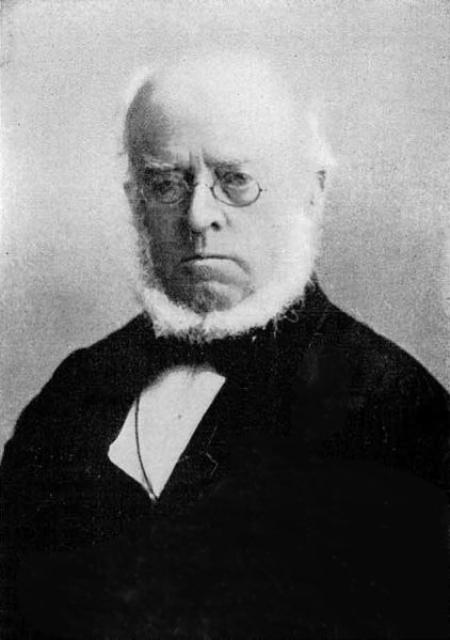
Adolph von Menzel
 Germany
- Adolf von Menzel: A Biography
- Early Works and Illustrations
- Recognition and Later Works
- Travels and Later Years
Adolf von Menzel: A Biography
Adolf von Menzel was a German artist and one of the leaders of romantic historicism. He was born in Breslau, Eastern Germany (now Wroclaw, Poland). In 1830, he moved with his family to Berlin. Menzel's first artistic training came from his father's lithographic workshop. After his father's death in 1833, Menzel became the family's breadwinner, taking on any job available, such as designing dinner menus and invitation tickets. He briefly attended classes at the Academy of Arts in Berlin but was mostly self-taught.
Early Works and Illustrations
Menzel gained recognition in 1833 with a sketchbook of pen drawings depicting the "Artist's Life." He followed this with a series of lithographed "Landmarks of Brandenburg History" (1834-1839) and his initial experiments in oil painting, including works like "A Game of Chess" (1836), "Legal Consultation" (1837), and "Court Session" (1837). However, he temporarily set aside painting to focus on illustrating Friedrich the Great by Kugler (1839-1842) and later illustrating a lavish edition of Kugler's works (1843-1849). These projects deepened Menzel's study of the era of Friedrich the Great.
Recognition and Later Works
Menzel gained a prominent reputation for his paintings inspired by this era, such as "The Round Table of Friedrich the Great" (1850), "Concert in Sanssouci" (1852), "Friedrich the Great on the Road" (1854), and "Friedrich the Great's Oath in Breslau, 1741" (in Breslau Museum), among others. In the 1840s, Menzel began painting directly from nature, creating landscapes and portraits that were first exhibited in 1906, changing the public's perception of his work.
In the 1850s, Menzel also painted several biblical scenes, although the excessive realism of these works often diminished their artistic value. He then showcased his talent once again with the magnificent "The Coronation of Friedrich Wilhelm I in Königsberg" (1861-1865), "The King's Departure for War, July 30, 1870" (1871), "The Ball Supper" (1878), "The Conversation between the King and a Lady at a Court Ball" (1880), "Religious Procession in Gastein" (1880), "Piazza Erbe in Verona," and "The Iron Rolling Mill" (1875) – the most remarkable of all his paintings, depicting the interior of an iron rolling mill during its operation. In addition to these works, Menzel created numerous other genre paintings, pen drawings, compositions for polygraphs, watercolors, and gouaches. He became a professor and member of the Academy of Arts in Berlin in 1856.
Travels and Later Years
Throughout his long life, Menzel traveled extensively, visiting Austria, the Rhine, the Danube, the Baltic Sea, the Netherlands, Italy, and exploring all of Germany. These travels provided him with inspiration for his drawings, genre paintings, and pastels. However, his later works lacked the poetic and emotional qualities found in his earlier pieces.
Menzel devoted over twenty years (1863-1885) to a series of watercolors and gouaches, compiled in the "Children's Album." This collection featured scenes of everyday life, depictions of animals, and birds. In his final years, Menzel focused on graphic art, although he never abandoned his pencil throughout his artistic career, with over five thousand of his drawings preserved in the National Gallery in Berlin.
On February 9, 1905, at the age of ninety, Menzel passed away. He received a grand funeral arranged by the Imperial Court, an honor typically reserved for field marshals.


