John F. Kennedy
 USA
USABiography of John Fitzgerald Kennedy
John Fitzgerald Kennedy, the 35th President of the United States, was assassinated in Dallas. No other president of the 20th century has captivated the imagination of contemporaries and penetrated the collective consciousness of Americans as deeply as John F. Kennedy. His youthful enthusiasm, cold rationality mixed with irony, and charm that captivated the media signaled a transition to a new generation that was determined to break free from the tranquility of the Eisenhower presidency and venture into unknown, fateful "new frontiers." Kennedy's presidency began on the brink of nuclear war, but he seemed to emerge even more hardened from one crisis after another. The White House, with his attractive family and the "brain trust" of his intellectual advisors, brought a breath of fresh air and soon became surrounded by the romantic aura of Camelot from the Arthurian legends. Washington, D.C. became the symbolic center of the superpower, responsible for the "Free World" and the global informal empire. The desire to create an idol of the "leader of the free world" became irresistible, and when Kennedy fell victim to an assassination after only two years and ten months in office, it plunged the nation and many Europeans into shock and mourning. Like after Lincoln's assassination, the image of the personal sacrifice in the name of high, universal values began to overshadow and transform historical reality. The "Kennedy myth" is still valid among broad sections of society today, although historians and journalists have long sought to create a sober and analytical, even extremely critical viewpoint.
Early Life and Education
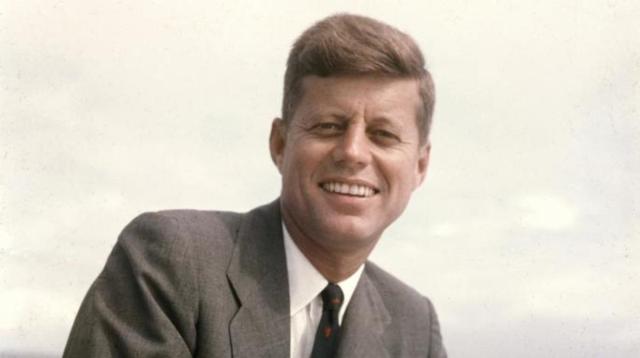
John Fitzgerald (Jack) Kennedy was born on May 29, 1917, in Brooklyn, Massachusetts, and was the second of nine children in an Irish-Catholic family that quickly became one of the wealthiest in the country and gained access to the elite of the East Coast. His father Joseph, who laid the foundation for a $200 million fortune with savvy stock market speculation in the 1920s, instilled in him a competitive spirit both physically and intellectually. His orderly and strict mother Rose showed little emotion towards the children. At a boarding school in Connecticut, John was an average student, but his classmates expected him to achieve great success in practical life. His studies at Princeton and Harvard were frequently interrupted by illnesses. His father's appointment as the U.S. Ambassador to London allowed him to live in England for a long time and make extended trips throughout Europe, where he witnessed the development of fascism up close. The debates about appeasement in British politics and American intervention in World War II became defining moments in his youth. Departing from his father's isolationism, in his senior thesis at Harvard, he advocated for a decisive fight for democracy against the totalitarian threat. The expanded version of this essay, titled "Why England Slept," was a great success after the fall of Paris in the summer of 1940. Thanks to his father's influence, Kennedy joined the U.S. Navy and served as the commander of a fast torpedo boat in the Pacific War against Japan. When his boat was sunk by a Japanese destroyer in August 1943, he managed to escape with the surviving crew members to an island and make contact with American forces despite being wounded. After a serious back surgery, he was honorably discharged from the Navy at the end of 1944 as a lieutenant. Health issues later attributed to that injury and a sports accident. However, the main cause was Addison's disease, the medication for which had numerous negative side effects. The extent to which this undisclosed condition, which often caused him severe pain, affected his performance as president remains a subject of debate.

Rise to Political Power
Since his older brother Joseph, a naval aviator, died in 1944, Jack became the hope of the Kennedy family. He inherited his father's ambition and, with the support of the family clan and a wide circle of friends, began systematically building a political career. His marriage to the elegant and attractive Jacqueline Lee Bouvier in 1953 proved very useful in this regard. Although Kennedy faced challenges in their relationship due to numerous love affairs (almost leading to divorce in 1954), Jackie always stood loyally by his side in public life and during his election campaigns. They had three children, one of whom died shortly after birth. Kennedy never lost an election, representing his Boston constituency as a Democratic congressman in Congress from 1947 to 1953, and then as a senator from Massachusetts in the second chamber. In domestic policy, he advocated for social reforms and better living conditions for the working class and minorities, while in foreign policy, he supported the Marshall Plan and NATO but criticized Truman's policy towards China. He spoke early on about the challenge posed by "Soviet atheism and materialism," which could only be countered by "constant vigilance." He observed Senator Joseph McCarthy's anti-communist campaign, which his father was close to, with a growing mixed feeling, but did not distance himself from it clearly. As a member of the Senate Foreign Relations Committee, Kennedy began to make a name for himself in speeches and articles on foreign policy issues, particularly showing interest in decolonization and new nationalism in Africa and Asia. Beyond the borders of the United States, he drew attention in 1957 when he criticized French colonial policy in Algeria and advocated for granting independence to the African country. He questioned conventional thinking by calling for increased development aid and understanding towards neutral tendencies in young states. Another key event that Kennedy shared with many Americans of his generation was the "Sputnik shock" in 1957. He concluded from the Soviet success in space that communist dictatorships were better armed for the future than the democratic West and that now it was necessary to eliminate America's "lag" in many areas, starting with education and ending with missile weapons, through doubled efforts. Since Kennedy lost the vice presidential nomination on the Democratic ticket by a small margin in 1956, he was considered a future figure in the party. In domestic policy, he moved towards the center-left sector, as evidenced by his advocacy for the rights of labor unions and African Americans. He used his reelection to the Senate in 1958 as a test for his bid to succeed Eisenhower. His victory with the largest margin of votes in the history of Massachusetts was practically the beginning of the presidential campaign in 1960. Thanks to a well-organized pre-election campaign led by his younger brother Robert (Bobby), he managed to surpass all intra-party competitors, including Hubert Humphrey and Lyndon Johnson. Despite the frequently cited circumstance that no Catholic had ever held the presidency before, he used it as a campaign tool, positioning himself as a defender of modern understanding of religion and the separation of church and state. The Democratic National Convention in Los Angeles nominated him as the presidential candidate in July 1960 in the first round, and Kennedy completed his success by selecting Southerner Lyndon Johnson as his vice presidential candidate. In the course of the campaign, he proclaimed a breakthrough to "new frontiers," and this slogan, with its strong appeal to the traditional American missionary and pioneering spirit, became a distinguishing feature of the Kennedy presidency. In the debates with his Republican opponent Richard Nixon, who had the advantage of being known as Eisenhower's vice president, Kennedy advocated for social reforms, progress, and forward movement in all areas. He primarily blamed the Republicans, without personally attacking the popular Eisenhower, for the loss of prestige of the United States in the world and promised to halt the dangerous decline of American power. At the same time, he appealed to the idealism of his fellow countrymen and their willingness to sacrifice, which resonated strongly, especially among the youth and intellectual circles. With money, the support of his family connections, and organizational talent, his brother Robert, Kennedy fought for the favor of voters and proved to be a more skilled candidate in the use of television, which played an important role in the election campaign for the first time. Many observers and scholars are convinced that the four major television debates between Kennedy and Nixon, watched by about 100 million Americans, had a decisive impact on the youthful-looking senator from Massachusetts. Rested and well-prepared, Kennedy dispelled doubts about his political experience and left a fresh and dynamic impression compared to the tired Nixon. On Election Day, however, Kennedy's advantage of approximately 120,000 votes, with a total of 68.8 million voters, was small. The victory in major cities, among Catholics and African Americans, was important. He owed the latter to his efforts to register black voters in the South and, possibly, a phone call to Coretta King, whom he assured of his solidarity with her arrested husband, civil rights leader Martin Luther King.
Presidency
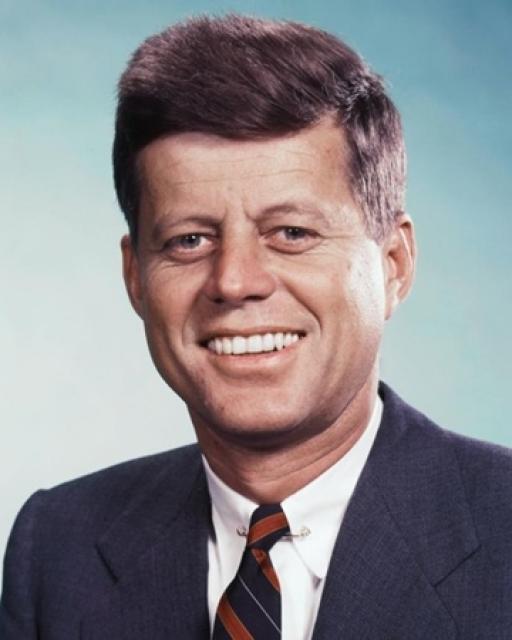
Kennedy's presidency was marked by new and unfamiliar territory from the very beginning. The first president born in the 20th century, he was simultaneously the youngest elected holder of the highest office in the history of the United States and the first Catholic in the White House. In his inaugural address on January 20, 1961, which he formulated together with his brilliant speechwriter Theodore Sorensen, with consideration of foreign policy, the president's concerns and ambitions were clearly expressed. On the one hand, he warned of the looming danger of nuclear annihilation, and on the other hand, he appealed to the vitality of the American nation, which is called upon to defend freedom. The whole world must know that Americans "will pay any price, bear any burden, meet any hardship, support any friend, and oppose any foe" to fulfill this mission. The global confrontation brings the "hour of maximum danger" closer, and the United States must engage in a "long twilight struggle." The later frequently quoted phrase, "Ask not what your country can do for you; ask what you can do for your country," called on each of his fellow countrymen to take personal responsibility for this existential competition. The speech made an impression but was not universally well-received. Its apocalyptic subtext, emphasis on self-sacrifice, and far-reaching hidden commitments to allies and "friends" concerned some attentive listeners. When distributing posts in the Cabinet and choosing an advisory staff, Kennedy had to take into account the sequence and bipartisan nature to a certain extent due to his small margin of victory in the election. He appointed the Republican pragmatist Douglas Dillon as Secretary of the Treasury, reinstated former Chief of Staff of the Army General Maxwell Taylor and appointed him a special military representative, and kept Allen Dulles as the head of the CIA to gain the trust of the business community, the military, and the intelligentsia. Recognizing that his victory had passed the "torch to a new generation," he surrounded himself primarily with younger specialists and managers who were admired as intellectual "eggheads" or viewed with suspicion. This group included his national security advisor McGeorge Bundy (born in 1920), the dean of Harvard University; specialist in economics and decolonization Walt Rostow (born in 1916), a professor of history at the Massachusetts Institute of Technology, and Secretary of Defense Robert McNamara (born in 1916), who rose to become the president of Ford Motor Company after studying economics at Berkeley and Harvard. His brother Robert Kennedy (born in 1925), also a Harvard alumnus, who served as Attorney General, exerted a strong influence, particularly in civil rights policy. Other trusted individuals included the Harvard historian Arthur Schlesinger Jr. (born in 1917), the lawyer Theodore Sorensen (born in 1928), who had been Kennedy's assistant since 1952, and press secretary Pierre Salinger (born in 1925). As Kennedy wanted to keep all the reins of foreign policy in his hands, he sent Adlai Stevenson as the U.S. Ambassador to the United Nations and chose Dean Rusk (born in 1909) from Georgia, a loyal and colorless figure who had been the end of the Rockefeller Foundation, as Secretary of State. He found a foreign policy advisor in the conservative camp in the person of Dean Acheson, who had been Secretary of State under Truman. With the Kennedy team, the average age of which was 45 (compared to 56 in the Eisenhower administration), a new spirit and style entered the White House. In accordance with Rostow's slogan, "Let's get this country moving again," the presidency was supposed to become a center of inspiration and initiative for the nation and the entire "Free World." While Eisenhower increasingly recognized the limits of his capacity for transformation and towards the end of his presidency displayed traits of passivity and disillusionment, Kennedy's administration was characterized by dynamic activity. It was based on the optimistic assumption that any problem could be solved through intellectual analysis and energetic leadership and that the United States, based on sheer willpower, could become a model of global modernization. This naive sense of "feasibility" and the exemplary character of American development for the world as a whole was characteristic of the "imperial presidency" that Kennedy represented better than his predecessors and successors. The transformation also affected the organization of the government apparatus, which Eisenhower had adapted to the military structure of the World War II staff. Kennedy, who had little experience with bureaucracy, replaced this system, based on hierarchical competence and clear adherence to orders through instances, with a flexible, unorthodox, and highly personal leadership style. The decisive center shifted from the president's office to the National Security Council, whose members often discussed upcoming issues in small, specially formed groups and committees. The council provided a forum for the administration's inner circle, which included Robert Kennedy, Arthur Schlesinger Jr., and Theodore Sorensen. Since Kennedy wanted to keep all the reins of government in his hands, he divided the policy areas among his advisors in such a way that none of them could gain too much influence.