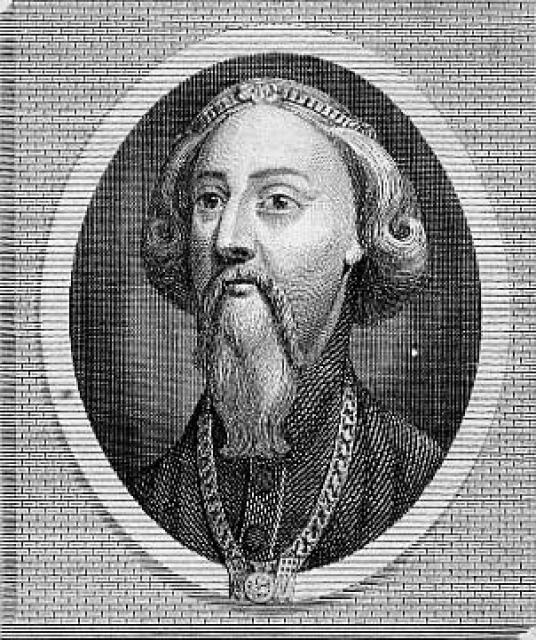
John Gower
 Great Britain
Biography of John Gower
John Gower was an English poet who lived in the late 14th and early 15th centuries. He was a wealthy nobleman from Kent and resided in London. Gower was a close friend of Geoffrey Chaucer, who entrusted him with his affairs during his absence from England and dedicated his work, "Troilus and Criseyde," to him. Gower was known for his generous donations to the monastery of St. Mary Overie in Southwark, where he lived and married Agnes Groundolf in 1397 or 1398.
Literary Works
Gower's most significant works were written in French and Latin. His first major poem, "Mirour de l'omme" or "Speculum meditantis," was written in French between 1376 and 1379. This poem consisted of over 30,000 octosyllabic lines, arranged in twelve-line stanzas with a rhyme scheme of aa vaavv vva. Gower was highly skilled in this technically challenging form. The poem deeply analyzed the manifestations of evil in contemporary society and was believed to be lost until its manuscript was accidentally discovered in 1895 at the University of Cambridge. Fifty French ballads by Gower also survived.
Gower's most significant work in Latin, "Vox clamantis," was an allegory consisting of 10,265 elegiac verses. It was written in 1382, although later revisions are possible. Like "Mirour de l'omme," "Vox clamantis" explored the various forms of evil in contemporary religious and socio-political structure. The first book of the seven books was dedicated to the history of the Peasants' Revolt in 1381.
Gower's most famous work, "Confessio amantis," was written in Middle English and survived in forty-three manuscripts. The first edition, dedicated to Richard II and Henry Lancaster, was composed around 1390, while the final revised edition was dedicated solely to Henry IV Lancaster. Consisting of over 34,000 lines, "Confessio amantis" was composed in short rhymed couplets, showcasing Gower's exceptional skill. The poem was a collection of stories and moral teachings, strung together by an allegorical framework in which Gower, as the lover, confesses his sins to the Genius and the priest of Venus. Each confession provides the Genius an opportunity for moral discussions. Gower's aim was to strike a balance between instruction and entertainment, and many of the stories in "Confessio amantis" can be considered narrative masterpieces. Around 1400, the poem was translated into Spanish and Portuguese, making it the first English work translated into a foreign language.


