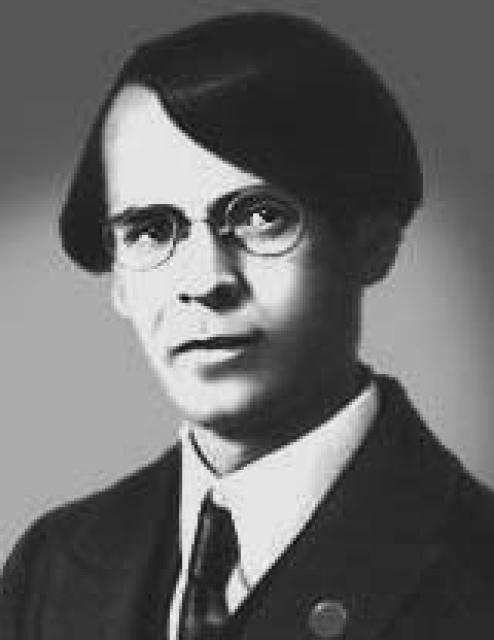
Vladislav Hodasevich
 France
Biography of Vladislav Khodasevich
Vladislav Khodasevich was a Russian poet who discovered his calling at a very young age, choosing literature as the main pursuit of his life. He wrote his first poems at the age of six. He was born on May 16 (28 NS) in Moscow, into a family of an artist. His father was from a Polish noble family, while his mother, who converted from Judaism to Orthodoxy, was raised in a devout Catholic Polish family. Khodasevich was baptized as a Catholic and took his father's last name.
During his childhood, Khodasevich had a passion for ballet, but had to give it up due to poor health. From 1903, he lived in his brother's house, who was a well-known lawyer. In 1904, he enrolled in the law faculty of Moscow University, but transferred to the philology faculty in 1905, although he did not finish the course. It was during this time that he attended the Moscow literary and artistic circle, where he had the opportunity to meet and listen to readings by prominent symbolist poets such as Vyacheslav Ivanov and Alexander Blok. His first book, "Youth" (1908), was heavily influenced by symbolism and its poetic clichés.
In the same period, Khodasevich also began his career as a critic. He reviewed publications by established symbolist poets as well as young literary talents. He welcomed the first books by Anna Akhmatova and Osip Mandelstam and recognized the poetic value of works by Nikolay Klyuev, Mikhail Kuzmin, and Igor Severyanin. Khodasevich engaged in debates with the acmeists and futurists, marking the formation of his own literary and historical concept. He believed in the importance of tradition and continuity in culture, emphasizing the role of literary conservatism in allowing for innovation without destroying the cultural environment.
In the 1910s, Khodasevich's perception of Vyacheslav Ivanov changed. In a review of Ivanov's book "Rainbow of Seven Colors" (1916), Khodasevich called him "the most deliberate person" who forced his true nature into an "ideal image." He had a long-standing friendship with Andrei Bely, whom he regarded as a person marked by unquestionable genius. In 1916, he became close to M.O. Gershenzon through the poet B. A. Sadovsky, considering him his "teacher and friend."
In 1916, Khodasevich's close friend, Munya (S. V. Kisin), committed suicide. This tragedy deeply affected Khodasevich, and he later wrote about it in his essay "Munya" ("Necropolis"). During 1915-1917, he focused intensively on translations, translating Polish, Jewish, Armenian, and Finnish poets. His translations of Jewish poetry reflected the fusion of "feeling and culture" and "national sentiment."
In 1916, Khodasevich contracted spinal tuberculosis and spent the summers of 1916 and 1917 in Koktebel, living in the house of M. A. Voloshin. Having been creatively nurtured in the atmosphere of symbolism but entering literature at its decline, Khodasevich, like Marina Tsvetaeva, described himself as one who "emerged from symbolism without attaching himself to anything or anyone, forever remaining alone, 'wild'". His book "Through the Grain" (1920), dedicated to the memory of his friend Kisin, demonstrated his literary independence and isolation.
In the 1920s, Khodasevich became one of the leading critics of emigration literature. He responded to significant publications both abroad and in Soviet Russia, engaging in debates and aiming to instill classical artistic skills in young emigrant poets. In his articles, he analyzed the dramatic aspects of emigrant literature and the crisis of poetry, linking it to the lack of a worldview and the overall crisis of European culture.
The last period of Khodasevich's creative life concluded with the publication of two prose books: the vivid fictional biography "Derzhavin" (1931), written in the language of Pushkin's prose, and the memoir "Necropolis" (1939), composed of essays written between 1925 and 1937. In these works, Khodasevich explored the lives of historical figures through the lens of their everyday realities, seeking to understand their true essence.
Khodasevich developed a deep spiritual connection with Alexander Pushkin, whose world and biography always attracted him. His articles on Pushkin's works analyzed various aspects, including self-repetition, preferred sounds and rhymes, and the incorporation of biographical materials into poetic narratives. Khodasevich's writings on Pushkin, along with his other literary criticism essays, were published in the collection "Articles on Russian Poetry" (1922).
In June 1922, Khodasevich left Russia with his wife N.N. Berberova and settled in Berlin. They later moved to Paris in 1925, where Khodasevich remained until the end of his life. In Paris, he continued his work as a critic, responding to literary publications and actively participating in the Russian emigrant community.
Despite his loyalty to many symbols of symbolism, Khodasevich, with his emotional openness and renewal of poetic language, belongs to the post-symbolist period of Russian poetry. His poems reflect the eternal conflict between the poet and the world, where each sound of reality torments, deafens, and wounds him.




