John Hartford
 USA
USABiography of John Hartford
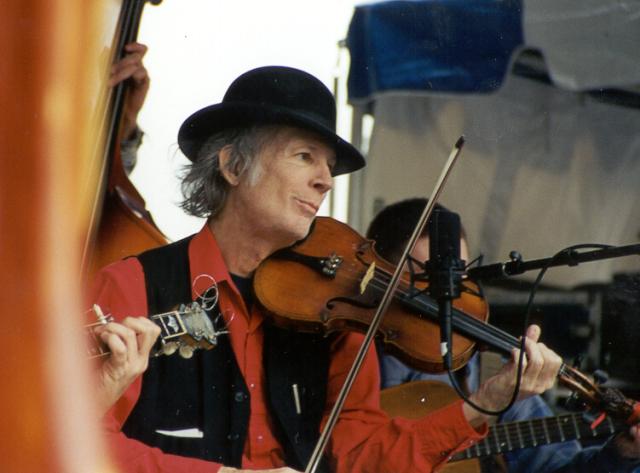
John Hartford was an American folk and country music singer, one of the most prominent figures in the bluegrass genre. He gained widespread recognition after the success of his ballad "Gentle On My Mind" in 1967, which became an American pop standard. Hartford collaborated with numerous musical ensembles and is known as one of the most skilled solo performers, playing multiple instruments such as guitar, banjo, fiddle, and mandolin. In total, over 300 different artists have recorded the song "Gentle On My Mind", including Elvis Presley, Aretha Franklin, Frank Sinatra, and many others.
Early Life and Musical Beginnings
John Hartford was born on December 30, 1937, in New York City, to Dr. Carl and Mary Hartford. He spent his childhood in St. Louis, where he developed a passion for music influenced by bluegrass banjo players Bill Monroe and Earl Scruggs. Hartford purchased his first banjo for $2 and quickly became proficient. His early musical abilities were shaped by listening to the radio show "Grand Ole Opry" in Nashville, where his favorite musician, Earl Scruggs, performed. Hartford once said that hearing Scruggs play the banjo for the first time changed his life. By the age of 13, Hartford was already a professional violinist and banjo player, and he soon learned to play the guitar and mandolin. He formed his first bluegrass band while still attending John Burroughs School.
After graduating from high school, Hartford enrolled at Washington University in St. Louis, where he studied applied arts for four years. However, his passion for music led him to drop out of college to pursue a career in music. In 1960, he received his degree. Hartford immersed himself in the local music scene, working as a DJ, playing in various musical groups, and occasionally recording singles for local labels. In 1965, he moved to Nashville, the center of country music, and a year later, in 1966, he signed a contract with RCA Records and released his debut album, "Looks at Life," in 1967. In the same year, he released his second album, "Earthwords & Music," which featured his hit song "Gentle On My Mind". The song became popular in the US and brought Hartford success after vocalist and guitarist Glen Campbell turned it into a hit in 1967. In 1968, Hartford won two Grammy Awards for his song "Gentle On My Mind" in the categories of Best Folk Performance and Best Country & Western Song.
Career and Legacy
Following the release of "Gentle On My Mind," Hartford's popularity continued to grow, and he soon moved to the West Coast. He became a regular guest on the "Smothers Brothers Comedy Hour" and was offered the lead role in a television detective series, but he turned it down to focus entirely on music. Hartford also appeared as a guest on television shows such as "The Glen Campbell Goodtime Hour" and "The Johnny Cash Show." Johnny Cash once wrote about Hartford, "His music and lyrics don't sound like anything I've ever heard. He's a guy who says and sings what he feels and experiences, a real personality because he has his own inner world." In the late 1960s and early 1970s, Hartford recorded four albums for RCA Records: "The Love Album," "Housing Project," "John Hartford," and "Iron Mountain Depot." In 1971, he began recording for Warner Bros. Records, where he had more creative freedom to explore unconventional musical styles. Hartford formed his own band, which included Vassar Clements, Tut Taylor, and Norman Blake, and began performing as a solo artist. He recorded several albums that defined the musical style of his later career, including "Aereo-plain" and "Morning Bugle." Sam Bush once said about Hartford's group, "Without Aereo-plain, there would be no newgrass music."
After leaving RCA Records, Hartford released albums on the Flying Fish Records label, continuing to perform with James Taylor, The Byrds, and his idol Bill Monroe. He continued to experiment with non-traditional country and bluegrass, collaborating with other country artists such as Sam Bush. During this period, he released two albums (in 1977 and 1980) recorded in collaboration with Doug and Rodney Dillard from The Dillards and Sam Bush. The sessions included work on songs such as "Boogie On Reggae Woman" and "Yakety Yak." In 1977, Hartford won his second Grammy Award for Best Ethnic or Traditional Recording for his album "Mark Twang."
Throughout his musical career, Hartford worked with many record labels. In 1991, he founded his own recording studio called "Small Dog a'Barkin' label." In the 1990s, Hartford returned to recording with Rounder Records, where he released many well-known songs that incorporated earlier forms of country music. Among them was the 1999 album "Retrograss," recorded in collaboration with Mike Seeger and David Grisman. Their repertoire included songs such as "(Sittin' on) the Dock of the Bay," "Maybellene," "When I'm Sixty-Four," and "Maggie's Farm." Hartford's songs were also included in the soundtrack of the film "O Brother, Where Art Thou?" for which he received a Grammy Award.
In 2001, Hartford embarked on his final tour, "Down from the Mountain." While performing in Texas in April of that year, he realized that he could no longer play his instruments due to the effects of his more than 20-year battle with lymphatic non-Hodgkin's lymphoma. Hartford passed away on June 4, 2001, at Centennial Medical Center in Nashville, Tennessee, at the age of 63.
Despite being considered one of the pioneers of the bluegrass movement, Hartford remained deeply devoted to traditional music throughout his life. His band and later recorded albums reflected his love for early bluegrass and the music of the past. Hartford's fascination with river culture and steamboats had been present since childhood. He once said, "I always loved boats, and I always loved the river." When I was in fifth grade, I had a schoolteacher who was a steamboat fanatic. In 1947, the old steamboat Golden Eagle wrecked in Illinois. The teacher managed to buy the pilot house and towed it on a flatbed truck. They put it in our schoolyard, and that made a huge impression on me."
Hartford actively combined his work on the river with his music. In the 1970s, he obtained a license to operate a steamboat. For many years, he worked on the Julia Belle Swain steamboat, piloting barges on the Mississippi, Illinois, and Tennessee rivers. The famous steamboat "Julia Belle Swain" is associated with Hartford's praise in the 1970s when he dedicated many of his songs to the beloved steamboat.
Hartford worked as a deckhand for the Mississippi Valley Barge Line and the Midwest Towing Company, towing coal barges. "We would load coal up and down the Illinois River between St. Louis and LaMont and serve the coal-loading docks along the Illinois River," Hartford remembered. "We would tow coal between Chester, Illinois, and St. Paul, Minnesota, on the upper Mississippi River."
In his later years, Hartford would return to the river every summer. "Being a riverboat pilot is a labor of love," he said. His home in Madison, Tennessee, was built to resemble a steamboat deck and is located on a bend in the Cumberland River.
John Hartford is remembered as an influential and innovative performer. He did not limit himself to one musical genre but continued to explore new sounds throughout his career. He continued to work on new songs until his illness prevented him from doing so. His unique approach to music is deeply appreciated, and his name has become a part of the history of American music.