John Herschel
 Great Britain
- John Herschel: Luminary of Astronomy and Physics
- Astronomical Pursuits
- Expedition to the Southern Hemisphere
- Scientific Publications and Legacy
- Photography and Other Contributions
- Later Years and Legacy
John Herschel: Luminary of Astronomy and Physics
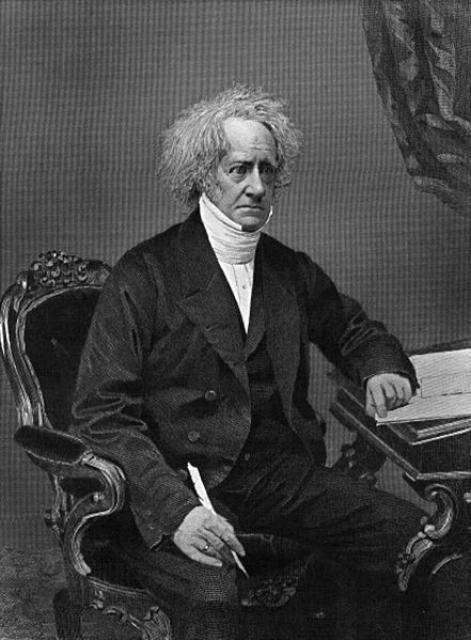
Early Life and EducationBorn in Slough, Buckinghamshire, on March 7, 1792, John Herschel was the son of renowned astronomer William Herschel. He received his education at St. John's College, Cambridge, graduating in 1813.
Astronomical Pursuits
After briefly pursuing mathematics and law, Herschel joined his father at his observatory in 1816. In 1822, upon his father's death, he continued his astronomical observations.
Herschel's early work focused on double stars, of which he discovered over 3,000. However, his main contribution was in the field of nebulae, cataloging 2,307 of these celestial objects.
Expedition to the Southern Hemisphere
In 1834, Herschel embarked on an expedition to the Cape of Good Hope, South Africa. There, he set up a large reflecting telescope and a smaller refractor. Over four years, he dedicated himself to studying the southern sky, discovering 1,202 double stars and 1,708 nebulae and star clusters.
Scientific Publications and Legacy
Returning to England in 1838, Herschel spent the next seven years describing his African research. In 1847, he published "Results of Astronomical Observations Made During 1834–1838 at the Cape of Good Hope," a landmark work in astronomy.
Herschel also authored "Outlines of Astronomy" (1849) and "General Catalogue of Nebulae" (1864). The latter, expanded later by Danish astronomer J. Dreyer and published as "New General Catalogue of Nebulae and Clusters of Stars" (1888), became a canonical reference for astronomers known as the NGC.
Photography and Other Contributions
Herschel made significant contributions to photography, discovering the ability of sodium thiosulfate to dissolve silver salts in 1819. Twenty years later, independent of W. Talbot, he proposed the use of light-sensitive paper for photographic images. He also introduced the terms "positive" and "negative" into photography.
Beyond astronomy, Herschel was involved in education and literature. He created a form of public education system in the Cape Colony. He became Honorary Chancellor of Aberdeen University in 1842. His "Preliminary Discourse on the Study of Natural Philosophy" (1830) was translated into several languages.
Later Years and Legacy
Like Isaac Newton before him, Herschel served as Master of the Mint (1850–1855). He died in Collingwood on May 11, 1871, leaving behind an enduring legacy in the fields of astronomy, physics, and beyond.