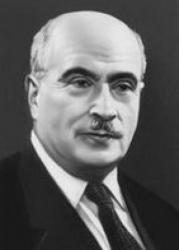
John Hogward Northrop
 USA
USA- Early Life and Education
- Research Career at the Rockefeller Institute
- Enzyme Research
- Continued Enzyme Discoveries and Nobel Prize
- Later Career and Legacy
Early Life and Education
John Howard Northrop was born in New York City on July 5, 1891, to Alice Bell (Rich) and John Isaiah Northrop, a zoology professor at Columbia University. His father died in a laboratory explosion shortly before his birth. Subsequently, his mother resumed teaching botany at Hunter College in New York City. She advocated for the introduction of nature study into secondary school curricula. Northrop completed elementary school and graduated from high school in New York City in 1908.
He attended Columbia University, where he focused on chemistry rather than biology. In 1912, he earned a Bachelor of Science degree and began graduate studies in chemistry. As a graduate student, Northrop joined Columbia's fencing team, which won the intercollegiate championship in 1913. He received his Master of Science degree that year and proceeded to a doctoral dissertation in chemistry, completing it in 1915. He worked as a mine surveyor in Arizona during the summer of 1915 while finishing his dissertation.
Research Career at the Rockefeller Institute
A William Bayard Cutting Traveling Fellowship enabled Northrop to work at the Rockefeller Institute for Medical Research (now Rockefeller University) with Jacques Loeb for a year. He was subsequently appointed first an assistant and then an associate in 1917. From 1920 to 1924, Northrop rose from an Associate Member to a Member of the Institute Corporation.
Enzyme Research
During World War I, Northrop served as a captain in the U.S. Army Chemical Warfare Service. He discovered a fermentation process that was used to produce acetone, an important industrial and scientific solvent. After the war, Northrop returned to the Rockefeller Institute and resumed his study of proteins and life span, which led him to explore the nature of enzymes.
In 1902, German chemist Eduard Buchner had discovered a group of proteins that acted as catalysts, known as enzymes. Enzymes facilitate chemical reactions, such as those involved in digestion. When Northrop began studying these vital compounds, their chemical nature was largely unknown. While many scientists believed that enzymes were proteins, the renowned German chemist Richard Willstätter had failed to isolate them in pure form, concluding that they were unlike any known organic compounds.
Challenging Willstätter's conclusion, Loeb proposed that enzymes were proteins and could be understood within the principles of chemistry. At Loeb's suggestion, Northrop attempted to purify pepsin, a digestive enzyme in the stomach, in 1920. That effort was unsuccessful, but Northrop and Loeb pursued further research, demonstrating that life span depended on temperature, with higher temperatures shortening lifespan. This discovery supported their belief that life was governed by chemical processes.
In 1926, around the time Northrop moved his laboratory to the Rockefeller Institute's branch in Princeton, New Jersey, James B. Sumner of Cornell University Medical College published findings on urease, an enzyme involved in breaking down urea. Sumner reported isolating the enzyme in crystalline form, proposing that it was a protein. Sumner's results were met with skepticism, but they inspired Northrop to renew his pepsin research, which culminated four years later in the isolation of crystals of a protein with pepsin-like properties.
Continued Enzyme Discoveries and Nobel Prize
In the 1930s, Northrop and his colleagues, most notably Moses Kunitz, isolated trypsin, chymotrypsin, and several other enzymes. Their work experimentally validated Sumner's theory and paved the way for intense research into enzymes. The next major breakthrough came in 1935 when Northrop's Rockefeller Institute colleague, Wendell M. Stanley, isolated crystals of the tobacco mosaic virus, a nucleoprotein. In 1939, Northrop became the first person to isolate a bacterial virus, and the following year, he crystallized diphtheria antitoxin.
During World War II, Northrop served as a consultant and held the formal position of investigator in the National Defense Research Committee. He developed methods for the automatic detection of chemical warfare agents.
In 1946, Northrop and Stanley were awarded the Nobel Prize in Chemistry, along with Sumner, "for the preparation of enzymes and virus proteins in a pure form." Arne Tiselius, presenting the prize on behalf of the Royal Swedish Academy of Sciences, remarked to Northrop, "You and your collaborators have raised the crystallization of enzymes and other biologically active proteins to an art, and you are its master." In his Nobel lecture, Northrop stated that the experiments of his fellow laureates and himself "support the conclusion that the enzymatic activity resides in the protein molecule itself and is not due to non-protein impurities."
Later Career and Legacy
Following the Nobel Prize, Northrop focused his research on viruses, investigating their nature and relationships. From 1949 to 1958, he was a professor at the University of California, Berkeley, while also serving as a professor and biophysicist at the university's Donner Laboratory. Northrop became an Emeritus Professor at the Rockefeller Institute in 1961 and of the University of California, Berkeley in 1962.
Northrop married Louise Walker in 1917, and they had a son and daughter. His son-in-law was Frederick C. Robbins. He died at his home in Wickenburg, Arizona, on May 27, 1987. An avid sportsman throughout his life, Northrop enjoyed hunting and fishing.
Among Northrop's many awards were Columbia University's Charles Frederick Chandler Medal (1937), the United States Certificate of Merit (1948), and Columbia University's Alexander Hamilton Medal (1961). He was a member of the U.S. National Academy of Sciences, the American Philosophical Society, and the American Academy of Arts and Sciences, as well as a foreign member of the British Chemical Society, the Royal Society of Arts, and the German Academy of Natural Scientists Leopoldina.