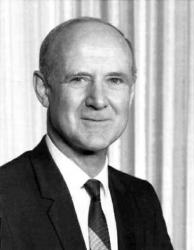
John Mainstone
 USA
USA- John Mainstone: The Keeper of the Pitch Drop Experiment
- Early Career and Appointment at the University of Queensland
- The Pitch Drop Experiment: A Journey of Patience
- The Significance of the Experiment
- The Intriguing Quirks of the Experiment
- Legacy and Recognition
- Personal Life and Family
John Mainstone: The Keeper of the Pitch Drop Experiment
John Mainstone, an American physicist, gained recognition as the "keeper" of the Pitch Drop Experiment, the longest-running laboratory experiment in scientific history.
Early Career and Appointment at the University of Queensland
Born and raised in the United States, Mainstone embarked on a career in physics. In 1961, he joined the University of Queensland as a lecturer. Over the years, he rose through the ranks, becoming a senior lecturer in 1966 and an associate professor in 1973. From 1989 to 1996, he served as head of the Physics Department.
The Pitch Drop Experiment: A Journey of Patience
Mainstone's most famous contribution to science stemmed from his involvement with the Pitch Drop Experiment, an experiment initiated in 1927 by Professor Thomas Parnell. The experiment aimed to demonstrate that seemingly solid materials are, in fact, fluids with incredibly high viscosity. Using a heated sample of pitch placed in a glass funnel, the experiment showcased the extremely slow flow and dripping of the substance. Each drop took approximately 10 years to form, with a total of 8 drops falling over the experiment's 83-year duration.
The Significance of the Experiment
While initially seen as an unusual experiment, the Pitch Drop Experiment had profound implications. It not only confirmed Parnell's original hypothesis but also provided an approximation of the viscosity of the pitch used. The experiment's continuous monitoring highlighted its importance in understanding the nature of matter and the behavior of liquids and solids.
The Intriguing Quirks of the Experiment
The Pitch Drop Experiment garnered attention not only for its scientific value but also for its quirky characteristics. The substance seemed to have a mischievous tendency to drip when no one was observing it. Despite the constant surveillance of recording devices, the cameras failed to capture the last drop's fall due to technical difficulties.
Legacy and Recognition
In 2005, Parnell and Mainstone received the Ig Nobel Prize for their experiment. After officially retiring, Mainstone continued to monitor the experiment until his passing. His dedication and unwavering commitment to this unique and long-term scientific endeavor serve as a testament to his passion for physics and the pursuit of knowledge.
Personal Life and Family
John Mainstone was survived by his wife, Claire, his daughters Julia, Penelope, and Catherine, and his three grandchildren. His legacy continues to inspire scientists and the public alike, demonstrating the power of patience, curiosity, and the enduring fascination with the mysteries of nature.