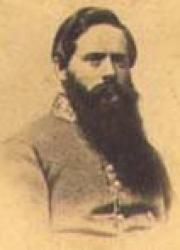
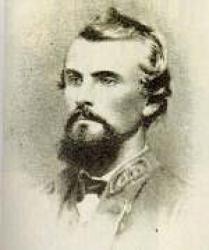
John Mosby
 USA
USABiography of John Singleton Mosby
John Singleton Mosby, the man who became a nightmare for the Union Army and a legendary hero of the Confederacy, was born in Edgemont, Virginia on December 6, 1833. He attended the University of Virginia in 1849, but was expelled after injuring his fellow student in a fight. He was fined $1,000 and sentenced to six months of imprisonment for "unlawful shooting," a sentence later overturned by the Virginia General Assembly. After his release, the former law student successfully passed the bar exams and opened his own law firm in Bristol.

Despite being against secession, Mosby immediately joined the Confederate Army following Virginia's secession from the United States. He believed that he couldn't fight against his own mother, as he famously said, "Virginia is my mother, God bless her. I cannot fight against my own mother." Mosby became a private in the 1st Virginia Cavalry under the command of "Grumble" Jones and participated in the First Battle of Manassas. Despite being undisciplined and headstrong, Mosby quickly rose to the rank of lieutenant and became an adjutant in the 1st Virginia.
During the Peninsula Campaign, Mosby volunteered to serve as a scout for Brigadier General Jeb Stuart and distinguished himself in June 1862 when Stuart bypassed General McClellan's army. Stuart described Mosby's service as a "brilliant example of bravery and effectiveness." On July 19, 1862, during the final battle of the Seven Days, Mosby was captured by the Union forces. He was held in Washington for ten days before being sent for exchange. While in the port, Mosby noticed a large number of Union transports carrying troops under Major General Burnside, heading to assist Major General Pope's army near Manassas. After the exchange, Mosby reported this information to General Lee, which ultimately led to the successful Southern attack on Pope's positions in August 1862.
However, Mosby's true fame came when he began implementing the tactics of Francis Marion, the famous "Swamp Fox" of the American Revolutionary War. Mosby believed that small and mobile cavalry groups were more effective in disrupting enemy communications than large offensive operations. In December 1862, he gained permission from Stuart to create an independent unit in accordance with the Confederate Partisan Ranger Act. The following year, Mosby recruited partisan rangers from Union-occupied areas of northern Virginia, forming a self-sustaining ranger unit. He began conducting raids on federal outposts and communications. Most of his men were volunteers who didn't want to serve in the regular army for various reasons. They lived at home with their families and only gathered when summoned by Mosby.
Mosby's tactics, which involved fast and nocturnal raids on Union trains, supply wagons, pickets, and camps, posed a significant threat to the federal forces stationed in northern Virginia. According to his own estimates, Mosby's operations diverted at least 30,000 Northern soldiers from the frontlines. In March 1863, he captured Brigadier General Edwin Stoughton in his own bed. In June 1863, Mosby's unit was reorganized into the 43rd Battalion Partisan Rangers and continued their lightning-fast raids against the enemy. Catlett Station, Aldie, and the Greenback Raid were just a few of their notable successes. By 1864, the 43rd Battalion had grown to 240 men and appeared seemingly out of nowhere, striking at the weakest and most vulnerable points of the Union. The key to their success was the unit's division into two or more detachments that operated in different locations. This allowed them to attack different targets in a single night, ranging from Sheridan's supply train in the Shenandoah Valley to pickets guarding the Baltimore and Ohio Railroad, and even the rear of the army maneuvering against General Lee.
In six months of 1864, Mosby's men destroyed, wounded, or captured 1,200 Federals, seized over 1,600 horses and mules, 230 head of cattle, and 85 loaded wagons. The Union army made futile attempts to put an end to Mosby's raids. Colonel Charles Russell of the 2nd Massachusetts Cavalry wrote, "Mosby is an old rat with many holes." Colonel Henry S. Gansevoort of the 13th New York Cavalry echoed this sentiment, stating, "The whole country is literally swarming with partisans, and fighting them is a thankless task. Mosby will always be after us." Lieutenant General Ulysses Grant was so angered by the ranger's successes that he ordered Mosby and his men to be hung without trial if captured. Major General Philip Sheridan formed a special unit consisting of a hundred killers armed with the latest Spencer carbines, with the sole purpose of capturing and destroying Mosby. However, on November 18, 1864, Mosby's rangers defeated this unit, leaving only a couple of "commandos" alive. The Union soldiers captured and declared outlaws were hanged without trial. In response, Mosby hanged an equal number of prisoners, all Union cavalrymen from George Custer's command. Only then did the Federal executions cease.
Grant resorted to other anti-guerrilla measures, such as ordering the destruction of all forage and food supplies in Loudoun County and the arrest of all men under the age of 50. However, none of these actions were able to stop Mosby, and as a result, the entire western Virginia became known as "Mosby's Confederacy." In December 1864, he was promoted to the rank of colonel, and his unit grew to eight hundred men. However, the war was nearing its unfortunate end for the Confederacy. Just twelve days after General Lee's surrender at Appomattox, on April 21, 1865, Mosby gathered his men for the last time in Salem, bid them farewell, and disbanded them.
After the war, John S. Mosby returned to his legal practice in Warrenton, Virginia, and became involved in politics. He surprised many in the South by supporting Grant's candidacy in the presidential elections. In 1876, he joined the Republican Party and helped Rutherford B. Hayes secure the presidency. From 1878 to 1885, Mosby served as the United States Consul General in Hong Kong, and from 1904 to 1910, he was an advisor to the Department of Justice. He passed away on May 30, 1916, in Washington, D.C., at the age of 82.