John Nash
 Great Britain
Biography of John Nash
John Nash, an English architect, was born in 1752 and studied under the architect R. Taylor. From 1784, Nash worked in Wales on various projects. In 1787, he was able to return to London, where he was well-received by society and gained favor with the Prince Regent (later King George IV).
Architectural Style and Collaborations
Nash's villas and castles, scattered throughout Britain, showcase a wide variety of architectural styles including classicism, neo-gothic, and Tudor style. For a time, Nash worked together with H. Repton, a renowned landscape architect. One of their notable joint projects was the Eastern-style palace, the Royal Pavilion, in Brighton (1815-1821).
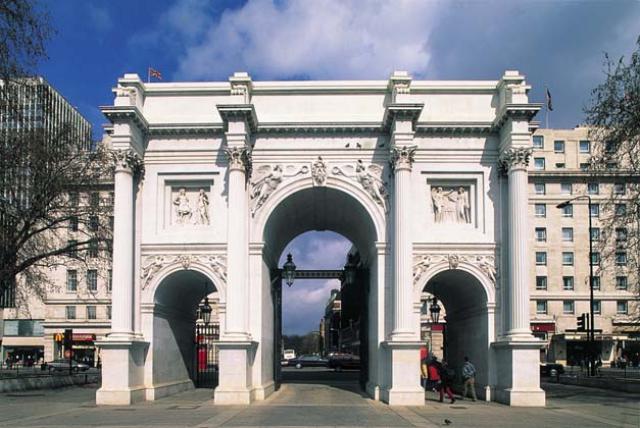
At the request of the Prince Regent, Nash developed one of the most daring urban planning concepts in London's history. This plan encompassed the area from the Mall in the south to the newly constructed Regent's Park in the north. Nash reconstructed the facades of the houses along Regent Street in a neoclassical style, creating a grand approach to Buckingham Palace. The new road was built between 1813 and 1820, and the architect aimed to design each block as a unified architectural ensemble (today, Regent Street is lined with upscale shops, and most of the buildings were constructed in the 1920s). Nash also designed the Marble Arch at the entrance to Hyde Park.
Later Life
After the death of King George IV in 1830, Nash lost his prestigious position at court and moved to his own home, East Cowes Castle on the Isle of Wight.


