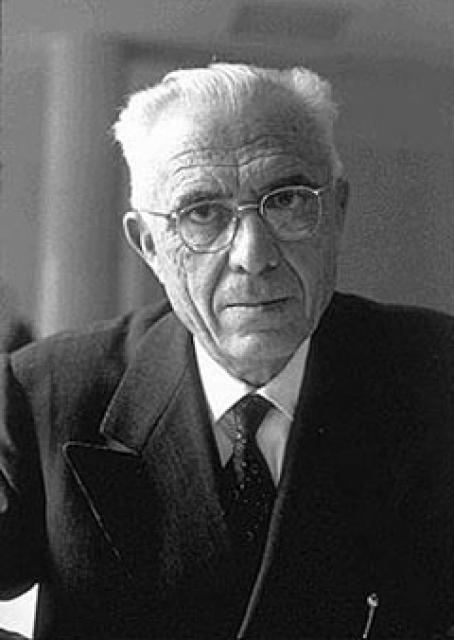
Pier Nervi
 Italy
ItalyBiography of Pier Luigi Nervi
Pier Luigi Nervi was an Italian architect, engineer, and art theorist, known as one of the leaders of avant-garde architecture. He was a master of constructions, most of which were made of ferroconcrete. His unique approach involved using this method to achieve a high level of perfection in the variety of forms created by assembling individual elements.
Early Life and Career
Pier Luigi Nervi was born on June 21, 1891, in the small town of Sondrio in northern Italy. He graduated from the engineering department of the University of Bologna in 1913, earning a degree in civil engineering. Immediately after graduation, Nervi began working at one of the most renowned engineering firms in Italy at that time, "Società per le Costruzioni in Cemento Armato," which had branches in Bologna and Florence. His work was interrupted from 1915 to 1919 by his service in the military engineering corps. After the war, Nervi resumed his work at the Florence branch of the company, not only as a designer but also as a project supervisor.
Architectural Achievements
In 1928, Nervi left his position at "Società per le Costruzioni in Cemento Armato" and established his own ferroconcrete construction firm, "Ingegneri Nervi e Nebbioso," in Rome, which operated until 1932. Here, he implemented his creative ideas, which became bolder as his fame grew. With Nervi's direct involvement, significant structures were built, such as a cinema and a funicular railway in Naples, bank buildings in Bari and other cities, a factory and a tuberculosis sanatorium in Lecce, and factories in Rome, among others. During this period, Nervi's theoretical views and his creative method were formed and perfected.
Later Years and Legacy
After the completion of the sports stadium for 35,000 people in Florence from 1929 to 1932, Nervi's name became widely known among the architectural and engineering communities in many countries. The construction of the stadium in Florence was carried out by a new firm, "Società Ingegneri Nervi e Bartoli," in Rome. This firm, which still exists today, has built numerous structures with Nervi's involvement.
In the mid-1930s to early 1940s, the Italian architecture was characterized by the fascist government's call for the construction of grandiose structures of exaggerated size, the revival of ancient traditions of imperial Rome, and the creation of "Mediterranean" architecture. From 1943 to 1945, Nervi's practical activities were somewhat reduced as he primarily worked on his book, "Construction - Art or Science?" In this book, Nervi summarized his previous work experience, defined his views on art and construction as a whole, attempted to determine the role of mathematical calculations in creating structures, and defended his perspective on the role of intuition in design.
In 1946, cement was first used in construction. Nervi's firm, "Nervi e Bartoli," constructed an experimental building - a small warehouse made of three-centimeter-thick sheets of ferroconcrete. In 1948, Nervi began designing and building a series of exhibition halls for the Exhibition Palace in Turin. He had the opportunity to showcase new constructions created by assembling prefabricated ferroconcrete elements.
In 1949, shortly after the completion of the Turin exhibition, Nervi built the swimming pool for the Naval Academy in Livorno. The vaulted covering of the pool was formed by prefabricated wave-like ferroconcrete elements of the same type used in the Turin hall, but curved in length to create a vaulted surface. Nervi also gained fame as a talented educator. In 1947, he became the head of the structural department at the architecture faculty of the University of Rome. From 1950 to 1952, he worked extensively in Latin America, where he taught architectural structures at the architecture faculty of the University of Buenos Aires. In 1950, he was awarded a doctoral degree in architecture in São Paulo.
In 1956, Nervi's firm, "Nervi e Bartoli," designed a thirteen-story building for the "Galbani" company in Milan. The sports facilities complex built in Rome for the 1960 Summer Olympics showcased the technical, spatial, and artistic possibilities of thin-walled structures made of prefabricated ferroconcrete elements.
In 1960, Nervi was awarded the Gold Medal by the Royal Institute of British Architects for his contributions to architecture. One of his most interesting structures, which occupies a significant place in modern international architecture, is the thirty-two-story administrative building for the "Pirelli" company, built by Nervi in collaboration with a group of architects in Milan from 1955 to 1959. The building stands at 124 meters tall. The main structural challenges in choosing the load-bearing scheme for this building were not only its considerable height but also its extremely unfavorable site plan - narrow and elongated.
During these years, Nervi was invited to work in other countries, and his firm, "Ingegneri Nervi e Bartoli," received numerous orders and carried out extensive construction projects. Nervi increasingly collaborated with his son, architect Antonio Nervi. Almost simultaneously, he designed projects for the United States and Australia. In 1961, he and Antonio designed the Liberty Bell Park Club and Racecourse in Philadelphia. In New York, the first building constructed according to Nervi's design was a bus terminal for two hundred buses, which was completed in January 1963.
Another notable work by Nervi, created in collaboration with metal construction specialist Gino Covre, is the covering of the Burgo Paper Factory in Mantua, completed in 1962.
Nervi was a master of constructions, most of which were made of ferroconcrete. His uniqueness lay in using this method to achieve a high level of perfection in the variety of forms created by assembling individual elements. Through his works, he demonstrated that ferroconcrete, mainly prefabricated monolithic constructions, were not only economical but could also be artistically complete.
Nervi's buildings played a significant role in the development of construction and architectural forms of his time. They continue to influence architects and engineers in different countries today. Nervi passed away in 1979.