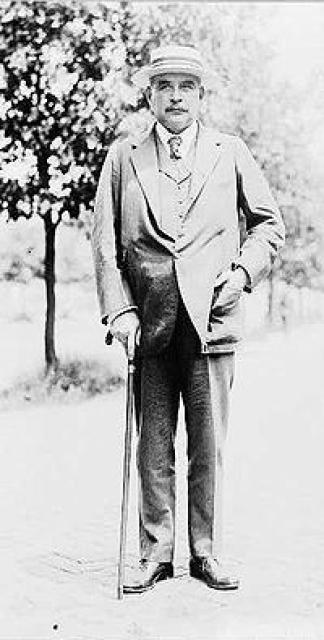
John Pierpont Morgan Jr.
 USA
USA- Early Life and Education
- Succession to Leadership
- Role in World War I
- Financial Diplomacy
- Philanthropy and Leadership
- Reorganization and Legacy
Early Life and Education
John Pierpont Morgan, Jr., was born into a prominent banking family, the son of John Pierpont Morgan. He graduated from Harvard University in 1889.
Succession to Leadership
After his father's death in 1913, Morgan, Jr., became the head of J.P. Morgan & Co. He oversaw the construction of the firm's new headquarters at 23 Wall Street, completed in 1914.
Role in World War I
Morgan played a significant role in financing World War I. In 1915, his bank provided a $50 million loan to France. J.P. Morgan & Co. became the exclusive purchasing agent for all British military purchases in the United States, acquiring cotton, steel, chemicals, and food. The bank's entanglement with British and French interests led to accusations of collusion with the U.S. government to support the Allies and secure its loans. Morgan organized a syndicate of approximately 2,200 banks and extended $500 million in credits to the Allies.
Financial Diplomacy
During the early years of World War I, U.S. Treasury Secretary William McAdoo and other members of Woodrow Wilson's administration viewed J.P. Morgan & Co.'s role as a British procurement and banking agent with suspicion. However, when the United States entered the war, this attitude gave way to close cooperation, with Morgan securing financial concessions. After World War I and the Treaty of Versailles, Morgan Guaranty administered German reparations payments. Morgan undertook trips to Europe to investigate and report on financial conditions, and by 1920, Guaranty had become one of the preeminent institutions in global banking as the leading creditor to Germany and Europe.
Philanthropy and Leadership
In 1924, Morgan established the Pierpont Morgan Library on Madison Avenue, based on his family's book collection. It is now a major research center. Morgan was also instrumental in implementing Roosevelt's New Deal and arranged a $100 million loan to Italian dictator Benito Mussolini prior to World War II.
Reorganization and Legacy
In response to new banking legislation (the Glass-Steagall Act) enacted in 1933, which prohibited investment banking except in government and municipal securities, the Morgans reorganized their business. They separated J.P. Morgan & Co.'s investment banking division into a separate firm named Morgan Stanley, founded by Morgan, Jr.'s son, Harry, and Harold Stanley. Morgan, Jr., also distinguished himself as a philanthropist, supporting the Episcopal Church, the New York Hospital, and the American Red Cross, where his partner Henry Davison was a leader.