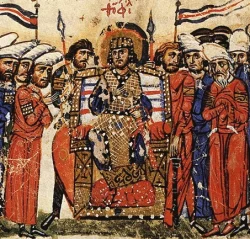
John V Palaiologos
Born in Constantinople on June 18, 1332, John V Palaiologos inherited an empire whose grandeur was increasingly at odds with its shrinking resources. He was the son of Emperor Andronikos III and Anna of Savoy. When his father died in 1341, the nine-year-old boy became emperor in name while a struggle over the regency plunged Byzantium into civil war.
A Throne Claimed in Childhood
The contest pitted John’s mother and her allies against John Kantakouzenos, Andronikos III’s powerful chief minister and military commander. Kantakouzenos proclaimed himself emperor, and the conflict lasted until 1347. He then entered Constantinople and reached a power-sharing settlement: he ruled as senior emperor beside John V, whose marriage to Kantakouzenos’s daughter Helena helped seal the agreement. The settlement was unstable. Renewed fighting in the early 1350s ended with John V reasserting his authority, and Kantakouzenos retired to monastic life in 1354.
The long reign that followed brought no lasting calm. Rival branches of the ruling family, aristocratic factions and foreign powers all competed for influence. The Black Death and economic strain compounded the pressures, while the Ottomans established themselves in Europe and steadily narrowed the territory available to the Byzantine government. The emperor’s title still carried historic prestige, but his ability to command events was increasingly constrained.
A Search for Western Aid
John sought help from Western Christian rulers and the papacy against the Ottoman advance. In 1369 he traveled to Rome and made a formal profession of Catholic faith before Pope Urban V, recognizing papal authority in the hope of strengthening cooperation. The gesture did not produce the military rescue he wanted, and it failed to settle the deep religious and political divisions between the eastern and western churches.
By the 1370s, Byzantine independence was further compromised. John accepted the Ottoman sultan Murad I’s suzerainty and agreed to pay tribute and provide military support. He was even drawn into Ottoman campaigns, a striking measure of how far the balance of power had shifted. Diplomacy and accommodation offered ways to keep the imperial state alive, but they also exposed its dependence.
Family Rivalries and Reversals
John’s eldest son, Andronikos IV, rebelled and seized the throne in 1376. John and his sons Manuel and Theodore were imprisoned, but in 1379 they escaped and regained Constantinople with outside support, including Ottoman backing. The emperor’s later years remained troubled by dynastic rivalry. In 1390 his grandson John VII briefly took the capital; John V was restored with the help of his son Manuel, who became the empire’s next ruler.
John V died in Constantinople on February 16, 1391, after a reign conventionally dated from 1341 but repeatedly interrupted by challengers. His story is one of persistence amid contraction: he survived civil wars and family coups, bargained with powerful neighbors, and tried to rally Western support as Byzantium lost ground. His reign did not end the empire, but it left his successor Manuel II facing an even more precarious struggle to preserve it.