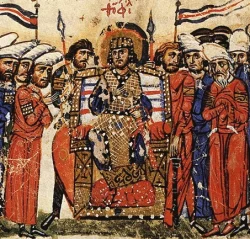
Romanos I Lekapenos
Romanos I Lekapenos rose from military service to become one of the most powerful rulers of the Byzantine Empire. He took control of the imperial government during a period of fragile succession, married his daughter to the young emperor Constantine VII, and eventually ruled as senior emperor from 920 to 944. His reign brought an end to a costly war with Bulgaria, strengthened the eastern frontier, and ended in a palace coup led by his own sons.
From the navy to the throne
Romanos was born around 870 into a family of modest provincial background. His exact origins are uncertain, though later tradition associated his family with Armenian ancestry. He built his career in the Byzantine navy and rose to senior command, gaining influence at a time when the empire was ruled by a child emperor and court factions competed for power.
After Emperor Alexander died in 913, Constantine VII was still young. Romanos emerged as a leading military figure and secured his position through a marriage alliance: his daughter Helena married Constantine. In 920, Romanos was crowned co-emperor and soon took precedence as the senior ruler. Constantine remained emperor in title and ultimately outlived him, but Romanos placed his own sons among the co-emperors, hoping to establish a dynasty of his own.
Peace and power
One of Romanos’ most important achievements was ending the long conflict with Bulgaria. After years of war under Tsar Simeon I, the new Bulgarian ruler Peter I made peace with Byzantium in 927. The agreement was reinforced by Peter’s marriage to Maria, Romanos’ granddaughter, who took the name Irene, meaning “peace.” The settlement brought relative stability to the Balkans and recognized Bulgaria’s imperial status.
Romanos also supported campaigns on the eastern frontier. His general John Kourkouas led expeditions that strengthened Byzantine positions against Muslim powers, while the emperor’s diplomacy helped secure prisoner exchanges. In 941, when a Rus fleet attacked Constantinople, Byzantine forces repelled it, including with the use of Greek fire.
At home, Romanos tried to protect small landholders from powerful aristocrats buying up their property, particularly after famine made rural families vulnerable. His legislation sought to limit such acquisitions and preserve the tax base and military obligations of village communities. These measures reflected the constant tension between the central state and landowning elites.
A family coup
Romanos’ position weakened after the death of his eldest son and intended successor, Christopher, in 931. His younger sons, Stephen and Constantine, feared that their father might leave the throne to Constantine VII’s line instead. In December 944, they seized Romanos and sent him to a monastery on the island of Proti.
The coup did not secure the dynasty they wanted. Constantine VII soon displaced the brothers and restored sole rule. Romanos remained in exile as a monk until his death in 948.
A ruler between dynasties
Romanos’ rise was remarkable: a naval commander from outside the established imperial family became senior emperor through military ability, marriage, and court strategy. He never entirely displaced Constantine VII, whose legitimacy endured, but he governed effectively for nearly a quarter-century. The peace with Bulgaria and support for smallholders stand alongside his family’s failed attempt to hold power. His reign was a brief Lekapenos interlude between phases of the Macedonian dynasty, but one that left the empire more secure on several fronts.