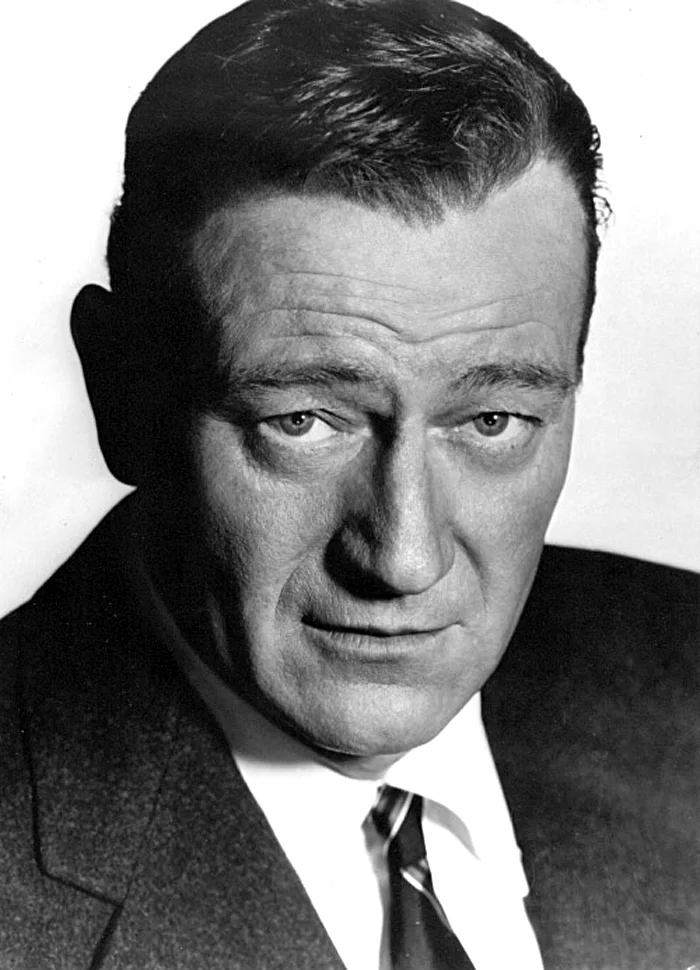
John Wayne
John Wayne became one of the defining faces of the American Western, a star whose screen persona blended toughness, humor, and a steady sense of authority. He appeared in more than a hundred films, from low-budget westerns to classics such as Stagecoach, The Searchers, and True Grit. His performances made him an enduring movie icon, while his conservative politics and the images of America in his films remain part of his complicated legacy.
From Iowa to Hollywood
Wayne was born Marion Robert Morrison in Winterset, Iowa, on 26 May 1907. His family moved to California while he was young. He attended the University of Southern California on a football scholarship, but a body-surfing injury ended his athletic hopes and interrupted his studies. He found work in Hollywood, first as a prop man and extra, then in small acting roles.
The studio gave him the screen name John Wayne, and he played leading roles in low-budget westerns through the 1930s. His breakthrough came when director John Ford cast him as the Ringo Kid in Stagecoach in 1939. The film made Wayne a major star and began a long creative partnership with Ford. Wayne’s measured delivery, physical presence, and easy authority helped define the Western hero for audiences around the world.
A major screen presence
Wayne continued to work with Ford and other leading directors, including Howard Hawks. In Red River, The Searchers, The Quiet Man, and Rio Bravo, he played characters who could be brave and steadfast but also stubborn, flawed, or morally conflicted. The Searchers in particular has been reexamined for its portrayal of racism and violence, revealing tensions beneath Wayne’s familiar heroic image.
He also appeared in patriotic and war films. In The Green Berets, which he co-directed and starred in, Wayne presented a strong defense of U.S. involvement in the Vietnam War. His political views were openly conservative and anti-communist, and he became a prominent public supporter of those positions. These commitments shaped his public image as much as the Westerns did.
In 1969, Wayne played the hard-drinking lawman Rooster Cogburn in True Grit. The role brought him his only Academy Award for Best Actor. He continued acting into the 1970s, including in The Shootist, a reflective Western that became his final film role.
Politics, illness, and legacy
Wayne’s film career was closely linked to a confident vision of American identity, but that image has never been universally embraced. Admirers saw a symbol of courage and individualism; critics have questioned the political messages of his films and their portrayals of Native Americans and other groups. His work reflects the era in which it was made and continues to invite debate.
Wayne was diagnosed with lung cancer in 1964 and underwent surgery. He later developed stomach cancer and died in Los Angeles on 11 June 1979. President Jimmy Carter awarded him the Presidential Medal of Freedom posthumously. Wayne’s influence endures through the Westerns he helped define and the screen persona he made unmistakable, even as audiences continue to reassess the myths and politics attached to it.