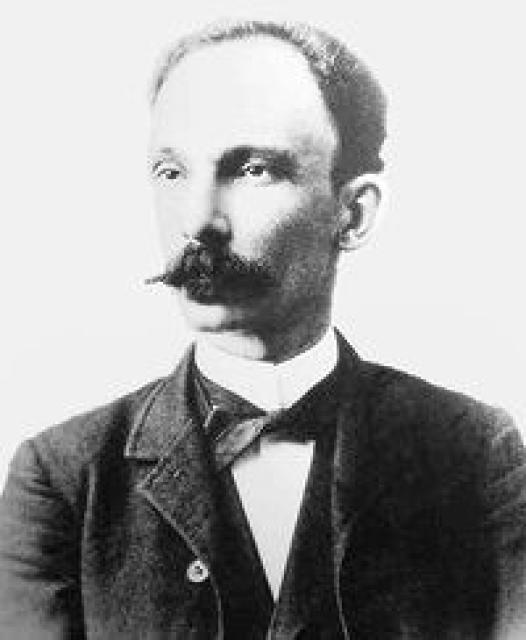
Jose Marti
 Cuba
CubaBiography of José Martí
Early Life and EducationJosé Julián Martí Pérez was born on January 28, 1853, in Havana, Cuba. He was the oldest son among seven sisters. His father, Mariano Martí Navarro, was from Valencia, Spain, and his mother, Leonor Pérez Cabrera, was from the Canary Islands. When Martí was four years old, his family moved to Valencia for a brief period before returning to the island. During this time, he attended a local school in the Santa Clara district while his father worked as a prison supervisor.
In 1865, Martí enrolled in a school led by Rafael de Mendive, who greatly influenced his interest in political philosophy. Martí's best friend, Fermín Valdés Domínguez, the son of a wealthy slave owner, also shaped his socio-political views. Together, they mourned the death of Abraham Lincoln and organized a tribute to honor the U.S. president for his efforts in abolishing slavery. In 1866, Martí entered an institute where he focused on finance and openly sympathized with the Cuban revolutionaries.
Imprisonment and Exile
On October 21, 1869, at the age of sixteen, Martí was arrested and accused of treason. He was sentenced to six years of imprisonment, despite the efforts of his mother and lawyer to overturn the verdict. Martí's legs were tormented by chains, and he fell seriously ill during his time in jail. After being repatriated to Spain, he was given the opportunity to continue his studies at the University of Madrid, as authorities hoped he would become loyal to them once again.
Instead, Martí wrote the brochure "Political Imprisonment in Cuba" to inform the public about the cruelty of his government. In November 1871, Martí fell ill again and underwent surgery. In June 1872, his friend, Fermín Valdés, was arrested and exiled to Spain, reuniting with Martí. They moved to Saragossa, where Martí continued his education at the University of Saragossa, earning degrees in humanities and law by 1874. When Martí was denied permission to return to Cuba in December 1874, he embarked on a journey through France, Mexico, Guatemala, and Venezuela, teaching and writing tirelessly about Cuban independence.
Family and Activism
On July 25, 1877, Martí delivered a speech at the opening of the literary society "Sociedad Literaria El Porvenir" at the Teatro Colón and was appointed its vice president. He also taught composition classes at a women's academy, where María García Granados, the daughter of the Guatemalan president, took notice of him. However, Martí did not respond to her advances and instead traveled to Mexico, where he met his future wife, Carmen Bazán. On May 10, 1878, Granados passed away from a lung illness, and the daughter of the president was later known as the "Guatemalan girl who died of love."
On November 2, 1878, Martí and Carmen had a son named José Francisco, also known as Pepito. Upon returning to Cuba in 1879, Martí participated in the preparations for an uprising against the Spanish colonial administration. Failing to meet the expectations of his government, Martí was once again exiled to Spain. From 1880 to 1885, he resided in the United States, where his family briefly joined him. During this time, Martí worked for Latin American newspapers, wrote articles and books, and continued teaching. However, dedicating himself entirely to the cause of Cuban independence, Martí struggled to support his family, and Carmen left him with their son in Havana on August 27, 1891.
Martí visited tobacco factories and addressed workers, urging them to prepare for a new uprising in Cuba. He also established the Cuban Revolutionary Party, uniting various emigrant organizations. On February 24, 1895, the National Liberation Uprising began, and Martí founded the newspaper "Patria" as the central organ of the newly formed party.
Death and Legacy
José Martí was killed in battle against Spanish troops near the Dos Ríos (Dos Ríos) site, where the Contramaestre and Cauto rivers merge, on May 19, 1895. The Spanish forces captured his body, buried it, and later exhumed it. It is said that the Spanish refrained from burning his body out of fear that the dispersed ashes might choke them. His death dealt a blow to the hopes of Cuban rebels, both on the island and abroad. However, the military actions continued with alternating successes and failures until the United States entered the war in 1898.
On June 30, 1951, a 24-meter mausoleum was inaugurated at the Santa Ifigenia Cemetery in Santiago de Cuba to honor José Martí.


