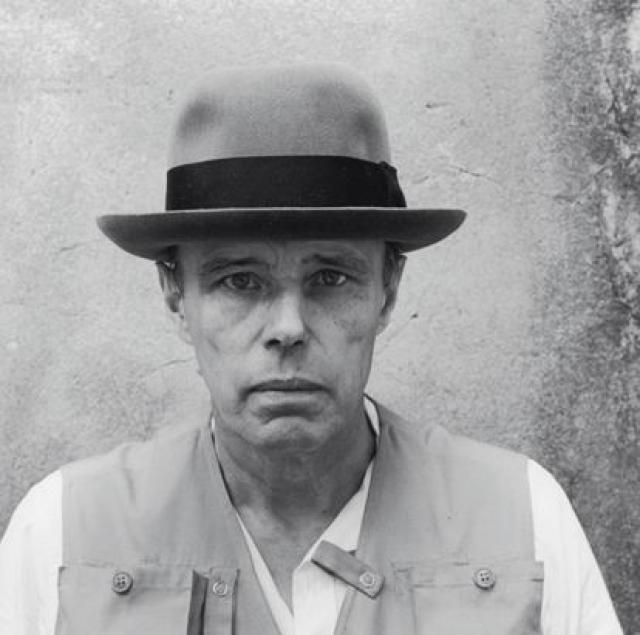
Joseph Beuys
 Germany
Joseph Beuys: Biography
Joseph Beuys was a German artist and one of the leaders of postmodernism. He was born on May 12, 1921, in Krefeld, North Rhine-Westphalia, into a merchant family. He spent his childhood in Kleve, near the Dutch border. During World War II, Beuys served in the aviation and his personal mythology, where fact was inseparable from symbol, began in the winter of 1943 when his plane was shot down over Crimea. The freezing "Tatar steppe," as well as the melted fat and felt that the locals used to save him, preserving his body heat, determined the symbolic structure of his future works. After returning to duty, he also fought in Holland. In 1945, he was captured by the British. From 1947 to 1951, Beuys studied at the Academy of Arts in Düsseldorf, where he was mentored by sculptor E. Mataré. He received the title of professor at the Düsseldorf Academy in 1961 but was fired in 1972 after "occupying" the secretary's office with rejected applicants as a protest. In 1978, the federal court declared his dismissal unlawful, but Beuys did not accept the professorship, striving to be as independent from the state as possible. Riding the wave of the left-wing opposition, he published a manifesto on "social sculpture" in 1978, expressing an anarchic-utopian principle of "direct democracy" aimed at replacing existing bureaucratic mechanisms with a sum of free creative expressions of individuals and collectives. In 1983, he ran for election to the Bundestag (on the Green Party list) but was defeated. Beuys died in Düsseldorf on January 23, 1986. After his death, every contemporary art museum sought to display one of his art objects in the most prominent place as a memorial. The largest and most characteristic of these memorials is the Worker's Block in the Hessian State Museum in Darmstadt - a series of rooms reproducing the atmosphere of Beuys' workshop, filled with symbolic materials ranging from rolls of pressed felt to petrified sausages. In his works of the late 1940s and 1950s, Beuys predominantly used primitive-style watercolor and lead pencil drawings depicting hares, deer, sheep, and other animals. He also practiced sculpture in the spirit of W. Lehmbruck and Mataré, fulfilling private orders for tombstones. Beuys was deeply influenced by R. Steiner's anthroposophy. In the early 1960s, he became one of the founders of "Fluxus," a specific form of performance art that was most prevalent in Germany. A charismatic speaker and educator, Beuys always addressed the audience with imperative agitational energy during his artistic actions, solidifying his iconic image during this period (felt hat, cloak, fishing vest). He used shockingly unconventional materials for his art objects, such as melted fat, felt, and honey. The archetypal, recurring motif was the "grease corner," evident in both monumental and more intimate variations, such as "Chair with Fat" (1964, Hessian State Museum, Darmstadt). These works vividly expressed the sense of modern man's alienation from nature and his attempts to reconnect with it on a magical-"shamanic" level. Among Beuys' notable performances are "How to Explain Pictures to a Dead Hare" (1965, with a hare carcass to which the artist "communicated" by covering his head with honey and gold foil), "Coyote: I Love America and America Loves Me" (1974, when Beuys spent three days sharing a room with a live coyote), "The Honey Pump at the Workplace" (1977, featuring a machine pumping honey through plastic hoses), and "7000 Oaks" - the most extensive action during the international art exhibition "Documenta" in Kassel (1982), where a huge pile of basalt blocks was gradually dismantled as trees were planted.