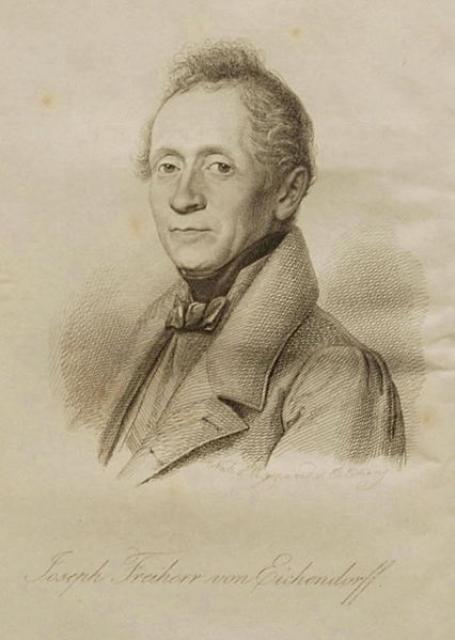
Joseph Eichendorff
 Germany
- Biography of Josef Eichendorff
- The Influence of Romanticism
- Professional Life and Literary Contributions
- Eichendorff's Poetry
- Josef Eichendorff passed away in Neisse on November 26, 1857.
Biography of Josef Eichendorff
Josef Eichendorff was a German writer who was born on March 10, 1788, in the castle of Lubowitz in Upper Silesia, into a noble family. He received his education at home during his childhood. In 1801, he enrolled in a Catholic gymnasium in Breslau (now Wroclaw, Poland), and in 1805, he began studying law at the University of Halle.
The Influence of Romanticism
In 1806, when the Napoleonic army invaded, the university was closed. Eichendorff spent the next two years in Heidelberg, where he became acquainted with C. Brentano and other leading representatives of Romanticism. After studying in Berlin and Jena for the following two years, Eichendorff joined the renowned volunteer flying squadron "Lutzow's Sharpshooters" in 1813, where he served until the end of the Napoleonic Wars in 1815.
Professional Life and Literary Contributions
After his marriage in 1816, Eichendorff worked as a civil servant in Berlin, Breslau, Danzig, and Königsberg. In 1844, he retired and lived in Neisse (Silesia) until his death. Despite his busy career, Eichendorff left a significant creative legacy in both poetry and prose.
He is the author of the extensive romantic novel "Ahnung und Gegenwart" (Premonition and Reality, 1815), five plays, eight novellas, several translations from Calderón and other Spanish authors, two literary-critical works, three small epic poems, and a volume of lyrical poetry (1837). Eichendorff's prose work of particular mention is the cheerful novel "Aus dem Leben eines Taugenichts" (Memoirs of a Good-For-Nothing, 1826).
Eichendorff's Poetry
As a lyric poet, Eichendorff undoubtedly stands alongside the greatest of the Romantics. His poems are characterized by freshness and optimism, which give him a unique place among his contemporaneous poets. Eichendorff had a remarkable talent for using precisely chosen words to recreate the desired atmosphere. Among his numerous sonnets, there are excellent examples of this genre in German literature, while his other lyrical poems are stylistically close to folk songs. Eichendorff's poems are so musical that over 1700 of them have been set to music, with his songs composed by Robert Schumann being the most famous.