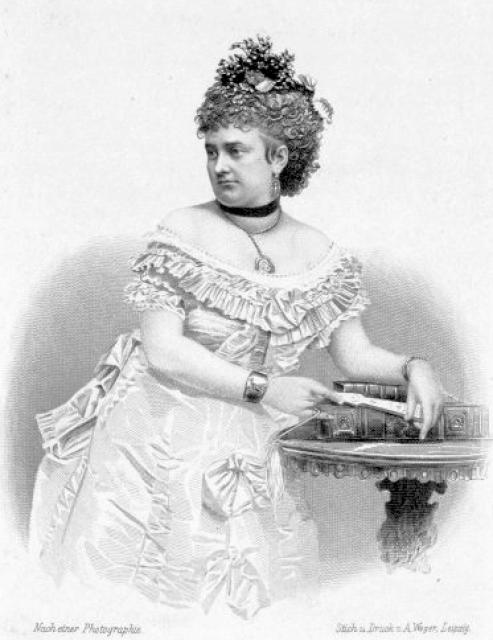
Josephine Schefsky
 Germany
- Biography of Josephine Scheffsky
- Early Life and Career
- Bayreuth Festival and Recognition
- Later Career and Retirement
- Later Life and Legacy
Biography of Josephine Scheffsky
Josephine Scheffsky was a German opera singer who reached the peak of her career in the second half of the 19th century. With a powerful voice and a wide vocal range, Scheffsky performed both soprano and mezzo-soprano roles. In modern times, she is remembered as one of the performers in the premiere of Richard Wagner's 'Der Ring des Nibelungen' at the very first Bayreuth Festival in 1876.
Early Life and Career
Josephine Scheffsky was born in 1843. Little information is known about her early life, but it is recorded that her professional debut took place in 1868 at the Bavarian State Opera, where she portrayed Orfeo in Christoph Willibald Gluck's 'Orfeo ed Euridice'. Until 1883, she was one of the leading artists at this theater and a favorite performer of King Ludwig II of Bavaria, who was an ardent fan of Richard Wagner's operas and adorned Bavaria with extravagant castles that cost a fortune.
Bayreuth Festival and Recognition
Richard Wagner heard Josephine Scheffsky perform in Munich and was highly impressed by her vocal and dramatic abilities. He invited her to participate in the premiere of the complete 'Der Ring des Nibelungen' cycle at the Bayreuth Festival in 1876. At the festival, Scheffsky became the first performer of the role of Sieglinde in 'Die Walküre' on August 14, 1876, and the second Norn in 'Götterdämmerung' on August 17, 1876.
Later Career and Retirement
In 1882, Scheffsky sang the role of Magdalene in the British premiere of Wagner's 'Die Meistersinger von Nürnberg' at the Theatre Royal, Drury Lane in London, conducted by Hans Richter. The following year, she left the Bavarian State Opera and performed at the National Rhine Opera and the Vienna State Opera from 1883 to 1884. She spent the last few years of her opera career at the Berlin State Opera and the Frankfurt Opera. Among the numerous roles in her extensive repertoire were mezzo-soprano parts such as Azucena in Verdi's 'Il trovatore', Fidès in Meyerbeer's 'Le prophète', Frau Reich in Otto Nicolai's 'Die lustigen Weiber von Windsor', Gertrude in Ambroise Thomas' 'Hamlet', and even Maddalena in Verdi's 'Rigoletto', although this role was originally written for a contralto.
Later Life and Legacy
In the early 1890s, Josephine Scheffsky retired from the stage and focused on teaching vocal music in Munich. She passed away on November 11, 1912, at the age of 69. Her contributions to the opera world and her memorable performances continue to be remembered and appreciated today.


