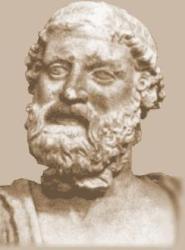
Jozue Carducci
 Italy
ItalyBiography of Giuseppe Carducci
Giuseppe Carducci, an Italian poet and critic, was born in Val di Castello, in northwest Tuscany. He was the eldest of three children of Michele Carducci, a doctor and member of a secret nationalist organization known as the Carbonari, which operated in Italy shortly before its unification. Due to his father's political views, harsh temperament, and strong anti-clericalism, the Carducci family had to frequently move from place to place. Eventually, they settled in Bolgheri, south of Livorno, where they lived for nine years. Because of the revolution that broke out in Italy and his father's hot temper, the family had to change their place of residence three times in 1848 and 1849. In 1849, the Carducci family moved to Florence, where Giuseppe, who had been educated by his father, enrolled in a middle school under the patronage of the religious order of the Piarists. Apparently, his home education was good, as he passed his first exams successfully. In school, Carducci read a lot, was passionate about the classics, and Italian writers of the 19th century, such as Alessandro Manzoni, whose novel "The Betrothed" he loved, as well as the poetry of Byron and Schiller. During this time, he also began writing poems on historical themes, translating the ninth song of the "Iliad," and composing satirical verses about his classmates and teachers, as well as lyrical poems such as "To My Mother" ("A mia madre"). In 1851, Carducci's father became an officer in the medical service in Chelle. The provincial atmosphere of this town did not contribute to the development of the young intellect, and Carducci spent his time learning patriotic songs with the village boys. Under the influence of his father, who had recently converted to Catholicism, Carducci wrote odes to St. Elizabeth and St. John the Baptist.
In 1853, Carducci received a scholarship to study at the prestigious University of Pisa. However, a year after his enrollment, he discovered that the professors here were too pedantic and the curricula hopelessly outdated. The main advantage of studying in Pisa was the opportunity to participate in a literary circle, of which the historian Erolo Scarameucci was a member. When Scarameucci passed away, Carducci delivered a eulogy praising his friend as a true patriot who had avoided the "sad and fruitless dreams" of Italy's unity supporters. The poet's attacks on the supporters of Italian unification, to whom he himself had recently belonged, are a typical example of how his political views changed throughout his life. In 1854, Carducci's father reinforced his reputation as a man lacking self-control by offending the mayor of Chelle, for which he was accused of insulting behavior and forced to resign from his position and become a low-paid surgeon in Piancastagnajo. Left without financial support, Carducci compiled a collection called "The Harp of the People: An Anthology of Religious, Moral, and Patriotic Poems by Italian Poets" ("L'arpa del popolo, scelta di poemi religiosi, morali e patnotici", 1855). The main goal of this collection, according to Carducci, was to uplift the moral and patriotic spirit of his readers.
At the same time, he wrote articles for the journal "The Supplement" ("L'appendice") published by his friend Pietro Tuaro, and soon became a leading figure among the writers who gathered around "The Supplement," aiming to defend the classicism of Italian poetry against what they called the "corrupting influence of romanticism." After completing his studies in Pisa, Carducci worked as a teacher at a gymnasium in the small town of San Miniato al Tedesco. However, his aggressive anti-clericalism and arrogance led to a reprimand from the Minister of Education, and he lost the opportunity to take a position in Arezzo, which he had hoped for. Carducci moved to Florence, and in 1857, he published his first collection of poems, "Rhymes" ("Rime"), which was later reissued in 1880 under the title "Youthful Poems" ("Juvenilia"). These sonnets and ballads, traditional in form, were characterized by deep patriotic sentiments and lacked romantic extravagance.
The years 1857 and 1858 were difficult for Carducci. Due to the lack of employment, he was financially constrained, and during these years, he had to endure the tragic deaths of his brother Dante in 1857 and his father a year later. However, soon his fortunes turned around, and in 1859, the poet married Elvira Menicucci. Within a year, he obtained a position as a Greek language teacher at the Faculty of the University of Pistoia, and a few months later, he became a professor of Italian literature at the University of Bologna, which allowed him to live comfortably and support his family – his wife, son, and three daughters. Carducci worked at the University of Bologna for most of his remaining life. In the early 1860s, he actively participated in the republican movement, which temporarily cost him his position at the university in 1863, and nearly resulted in him losing his chair in 1867. The publication of his most scandalous poem, "To Satan" ("Inno a Satana"), in 1865 also had consequences. This pantheistic and anti-clerical work celebrated the triumph of human reason and progress over the tyranny of Christian theology. A year after the poem's release, Carducci was elected to parliament as a member of the Republican Party, although he was unable to fulfill his duties due to various formal circumstances.
In 1878, Carducci published the first of three volumes of "Barbarian Odes" ("Odi barbare"), in which he attempted to capture the spirit of antiquity and imitate the rhythmic structure of Greek and Latin poetry. The "Barbarian Odes," with their historical theme, as well as the more lyrical "New Poems" ("Rime nuove") published from 1861 to 1887, are considered to be his best and most skillful works. Carducci also published other notable poetry collections such as "Light and Serious" ("Levia gravia"), "Iambs and Epodes" ("Giambi ed epoch"), and "Rhymes and Rhythms" ("Rime e ritmi"), although critics believe that the latter collection is somewhat inferior to the previous ones. In his best poems, Carducci's deep but somewhat distant vision of the continuity of human existence is felt. Regardless of whether his poems follow the forms of ancient poetry or the traditional meters of Italian verse, the poet strives to avoid romantic extravagance and maintains a strict classical style. Although Carducci's reputation has always been based primarily on his poetry, to which he dedicated himself almost like a sacred act, his poetic legacy is relatively small. Out of thirty volumes of his collected works, only four volumes are dedicated to poetry. Primarily, the poet wrote monographs and essays of a scientific and polemical nature, covering a wide range of topics from literary criticism to politics.
In his later years, Carducci, who was also a brilliant orator, was considered the national poet of Italy and enjoyed a reputation as one of the most educated men of his time. In 1890, he became a senator, partly due to his literary reputation and partly due to his changing political views: in his old age, the poet became a monarchist and a supporter of Italy's expansionist policy in Africa.
Carducci's candidacy for the 1906 Nobel Prize was unquestionable, as he had been on the list of candidates since 1902. The poet was awarded the prize "not only for his profound knowledge and critical mind, but above all for his creative energy, freshness of style, and lyrical power, so characteristic of his poetic masterpieces."
During the award ceremony, S.D. Virsén, a member of the Swedish Academy, related Carducci's biography to the history of Italy's political life. According to Virsén, Carducci's "paganism" was a reaction to the excesses of Catholicism rather than a rejection of Christianity. "Carducci is an educated historian and literary scholar, nourished by ancient literature, as well as Dante and Petrarch," noted Virsén. "He is dedicated... to the ideals of antiquity and the humanism of Petrarch." Virsén added, "The indisputable truth remains that the poet, driven by the ideals of patriotism and liberty, is always a person of the highest spirit."
Due to his weak health, Carducci was unable to attend the award ceremony in person. He passed away a year later. Currently, Carducci's works are mainly read by literature specialists, who often highlight the vitality and universality of his poetry. His work is closely associated with the Risorgimento, the 19th-century movement that aimed for the political unification of Italy.