Judah Loew ben Bezalel
 Czech
Czech- Biography of Yehuda Loew ben Bezalel
- Early Life and Education
- Legendary Figures and Contributions
- Legacy and Influence
Biography of Yehuda Loew ben Bezalel
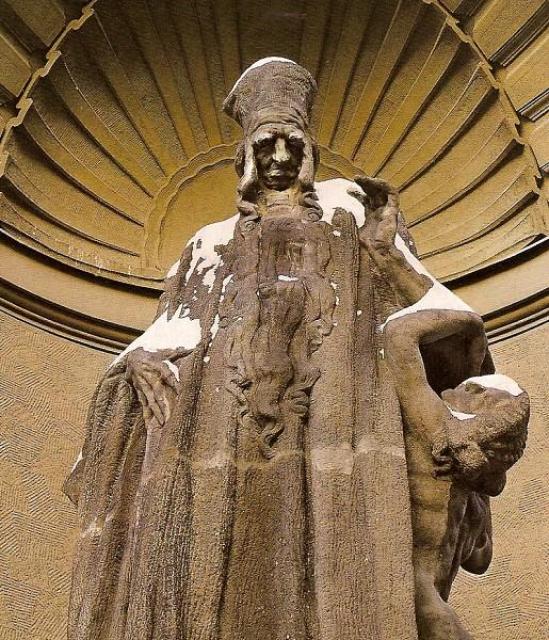
Yehuda Loew ben Bezalel, also known as Maharal, was a renowned Prague rabbi, scholar, and one of the most authoritative religious theorists of the 16th century. Although much of the information about his life and religious activities is surrounded by myths and legends, his interest in Kabbalah and secret teachings has added to his mystique. However, there are some documented dates and events that can be reconstructed.
Early Life and Education
Yehuda Loew ben Bezalel was born in Poznań, located in present-day Poland, into a Jewish family. Some researchers believe that his family was very religious, and his uncle was a prominent rabbi in the country. However, it is still unconfirmed whether Yehuda received any religious education himself. Nevertheless, in 1553, he moved to Moravia, where he served as the chief rabbi for 20 years. He then relocated to Prague, which marked the peak of his scholarly and spiritual activities. From 1597 until his death in 1609, he held the position of chief rabbi of Prague.
Legendary Figures and Contributions
Yehuda Loew ben Bezalel's name has endured throughout history due to the legends that surround him in Prague. It is said that during a fire, he risked his life to save King Rudolf II's library. Furthermore, during a parade, the rabbi calmed the emperor's enraged horse, which earned him the emperor's trust and a place in his inner circle. Despite Kabbalah being a component of Judaism, practical Kabbalah, involving magic and supernatural forces, was never encouraged by rabbis. However, according to legends, Yehuda used his secret knowledge to create the legendary Prague golem, a character who became the prototype for Frankenstein, the robots of Čapek, and many other memorable figures in world literature.
The golem was created to protect the Jewish population of Prague from anti-Semitic movements. Over time, the golem became a symbol of the defender of the Jewish quarter of Prague and a cherished relic whose location was carefully hidden from authorities and much of the Jewish community. It is rumored that during World War II, the golem was secretly taken out of Prague, an event later depicted in Michael Chabon's book "The Amazing Adventures of Kavalier and Clay".
Yehuda Loew ben Bezalel's literary legacy consists of numerous books on both spiritual and secular themes. His commentary on the Torah, the Five Books of Moses, surpassed the philosophical thought of its time. His works on Kabbalah and Jewish philosophy also marked further development in Jewish ethical thinking. He was a natural educator and devoted special attention to the upbringing of children. In the 16th century, he attempted to find a compromise between religious and secular education, arguing that no scientific discipline would corrupt the soul of a young individual but rather strengthen it and provide a foundation for further education.
Legacy and Influence
Yehuda Loew ben Bezalel was a proponent of freedom of speech and thought throughout his life. He actively engaged in ideological debates and became a precursor to the European revolutions that occurred much later. Assessing his impact on contemporary Judaism is challenging as opinions vary. Some consider him the founder of Hasidism, while others believe he introduced the mysteries of Kabbalah to the world. Some see him as a humanist and advocate for human freedom, irrespective of religious beliefs. Yehuda did not establish a school around him, and his ideas were only fully appreciated much later, as his contemporaries could not fully grasp the depth of his thoughts.
He passed away in 1609 and was buried in the Old Jewish Cemetery in Prague. His burial place quickly became sacred for the city's Jewish residents and gradually attracted visitors. Today, Yehuda's tomb and the nearby synagogue hold special significance in Jewish culture.
Despite publishing his first work at the age of 66, Maharal is recognized as a precursor to most movements within Judaism. His teachings and ideas continue to inspire and influence contemporary Jewish thought.