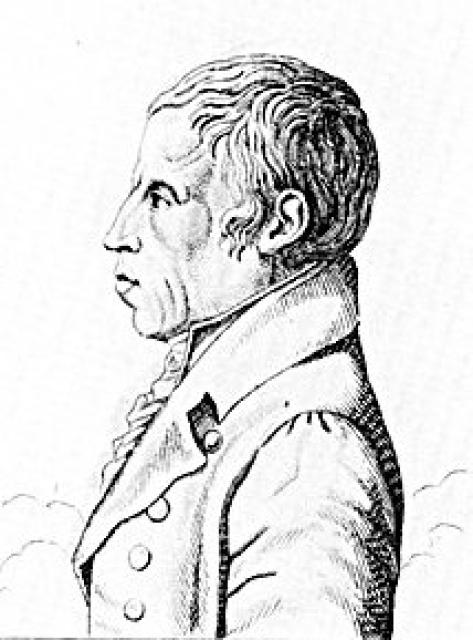
Julius Klaproth
 Germany
Biography of Julius Klaproth
Julius Klaproth was a German orientalist, traveler, and polyglot. He showed remarkable language abilities at a young age, and in 1802, his first work Asiatisches Magazin was published. In 1805, he was elected as a foreign member of the Imperial Academy of Sciences in St. Petersburg and participated in the embassy of Count Y.A. Golovkin to China (the Manchu authorities did not allow the envoys to proceed beyond Mongolia).
During his stay in Russia, Klaproth's scientific contributions were highly productive. Financed by the academy, he undertook trips to Siberia (1805-1806) and the Caucasus (1807-1808), where he collected diverse materials for studying the lesser-known peoples of these regions in Europe at the time. By 1810, Klaproth had prepared the "Chinese Dictionary" and other works on Sinology and Manchu studies, but their publication was hindered by the lack of necessary technical resources. Consequently, the question arose of his trip to Berlin, where the required Chinese and Manchu words, about 9000 in number, were to be made "on wood according to his own drawings". On November 27, 1810, Alexander I approved this assignment for a period of six months.
In late December 1810, Julius Klaproth received an academic advance payment for six months and 750 rubles "for cutting out words" and left Russia. The assigned period passed, and almost a year went by without any news from Klaproth. On April 19, 1812, Minister of Public Education Alexey Razumovsky issued an order for Klaproth's return from the prolonged assignment and instructed to prepare a passport in his name. In response to this order, Julius Klaproth sent a letter full of insults to the Imperial Academy of Sciences from Berlin, dated June 25, 1812. He refused to return to Russia and demanded his dismissal from the academic staff. On August 12, 1812, a Conference was held and adopted a resolution to remove Julius Klaproth "with disgrace from the Academy of Sciences". However, he remained an academician for another five years, as it was not until April 19, 1817, that Alexander I confirmed this decision.
From 1815 onwards, Julius Klaproth lived permanently in Paris. Upon recommendation from Alexander von Humboldt, he received the title of professor and financial support from the Prussian king, with the right to live in Paris and engage in scientific work.
Klaproth's scientific method was characterized by an extensive approach to research. His treatise "Asia Polyglotta" was a compilation of all scientific knowledge accumulated at the beginning of the 19th century, offering a new classification of Eastern languages, including Chinese, Manchu, and Ancient Egyptian. This work is now considered a historical monument. His more well-known work, "Itinerary of Chinese Traveller," was published in 1821. He also translated early Japanese poetry.
While primarily a sinologist in terms of his scientific interests, Julius Klaproth, as a linguist and historian, also dealt with linguistic data of various other Eastern languages. In collaboration with linguist and Russian diplomat Ivan Gulyanov (1786-1841), he criticized the methodology of reading Egyptian hieroglyphs proposed by Jean-François Champollion (1790-1832).


