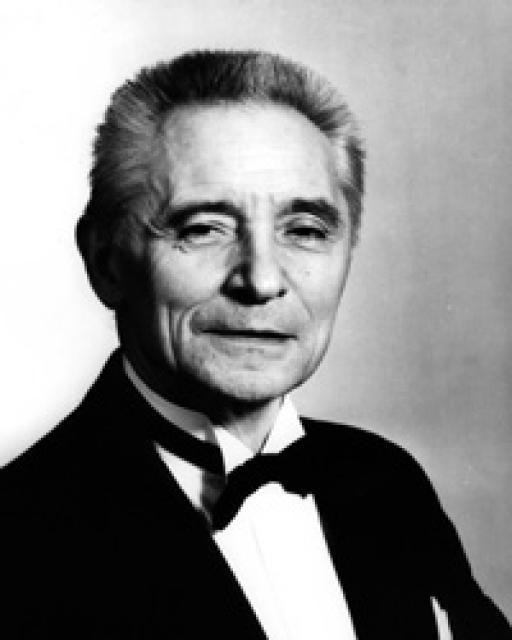
Juriy Grigorovich
 Russia
Biography of Yuri Grigorovich
Yuri Grigorovich is a Soviet and Russian ballet artist, ballet master, distinguished choreographer, educator, and professor. The genius of Russian music, Dmitry Shostakovich, once said: "In his choreographic images, true poetry lives. The best of choreography is expressed in the combination of classical traditions and modern means. Dance triumphs here. Everything is expressed, everything is told by its richest language - figurative, unique, opening, I think, a new stage in the development of Soviet theater." Yuri Grigorovich was born on January 2, 1927, in Leningrad. His father, Nikolay Grigorovich, was a civil servant, and his mother, Klavdia Alfredovna Grigorovich (nee Rozay), was a homemaker. His wife is Natalia Bessmertnova, a People's Artist of the USSR. Yuri Grigorovich's parents were not involved in the arts, but they loved and took his interest in ballet very seriously. His maternal uncle, G.A. Rozay, was a prominent dancer, a graduate of the St. Petersburg Ballet School, and a participant in the Paris seasons of Sergei Diaghilev's enterprise. This greatly influenced the boy's interest in ballet, so he was sent to study at the famous Leningrad Choreographic School (now the State Academy of Choreography named after A.Ya. Vaganova), where he studied under the guidance of teachers B.V. Shavrov and A.A. Pisarev. Immediately after graduating from the choreographic school in 1946, Yuri Grigorovich was admitted to the ballet troupe of the State Academic Opera and Ballet Theater named after S.M. Kirov (now the Mariinsky Theater), where he worked as a soloist until 1961. Here he performed character dances and grotesque roles in classical and modern ballets. Among his roles during this time were the Polovtsian in "Prince Igor" by A.P. Borodin, Nurali in "The Fountain of Bakhchisarai" by B.V. Asafyev, Shurale in "Shurale" by F.Z. Yarullin, Severian in "The Stone Flower" by S.S. Prokofiev, Retiarius in "Spartacus" by A.I. Khachaturian, and others.
Despite his success in dance, the young artist was drawn to independent ballet mastering work, composing dances, and staging large-scale productions. As a very young man, in 1948, he staged the ballets "Aistyonok" by D.L. Klebanov and "The Seven Brothers" to the music of A.E. Varlamov at the Leningrad House of Culture named after A.M. Gorky. The performances were successful and drew the attention of specialists to the emerging choreographer. However, real success came to Yuri Grigorovich after he staged the ballets "The Stone Flower" by S.S. Prokofiev (based on the story by P. Bazhov, 1957) and "Legend of Love" by A. Melikov (based on the play by N. Hikmet, 1961) on the stage of the Kirov Theater. Later, these productions were transferred to the Bolshoi Theater (1959, 1965). Yuri Grigorovich also staged "The Stone Flower" in Novosibirsk (1959), Tallinn (1961), Stockholm (1962), Sofia (1965), and other cities; and "Legend of Love" in Novosibirsk (1961), Baku (1962), Prague (1963), and other cities.
These performances were highly successful, received significant attention from the press, and marked the beginning of a new stage in the development of Soviet ballet. It is worth noting that it was precisely at the turn of the 1950s-1960s that a new generation of talented young creators emerged in all areas of Soviet art: poetry and prose, painting and theater, music, and cinema. They determined the main achievements of Soviet artistic culture in the second half of the 20th century. They later became known as the glorious "sixties generation." Yuri Grigorovich belongs to this generation. What is the fundamental breakthrough that occurred in our ballet with Grigorovich's first mature performances? They summed up the achievements of the preceding ballet theater but took it to a new level. They deepened the traditions of choreographic art, revived forgotten classical forms, and enriched ballet with innovative achievements.
These productions have a profound ideological and image interpretation of the literary original that formed the basis of their scenarios. They have consistent and cohesive dramaturgy, psychological development of character. However, unlike previous ballet plays, where dance was often sacrificed for mime, and ballet resembled a dramatic play, here dance reigns supreme. The action is expressed primarily through dance, and as a result, complex forms of choreographic symphony are revived, achieving a closer integration of choreography with music, embodying the internal structure of music in dance, and enriching the vocabulary of dance. The choreographic solution in these productions is based on classical dance, enriched with elements of other dance systems, including folk dance. Elements of pantomime are organically incorporated into dance, which remains effective. Grigorovich achieved a high level of complex symphonic dance (the fair in "The Stone Flower", the procession and vision of Mekhmena Banu in "Legend of Love"). Here, Grigorovich does not present dances at the fair (as in ballets of the previous period), but rather presents the fair in dance. It is not a mundane procession but a dance image of a solemn procession, and so on. Chorus ballet is used not only to depict a crowd of people on stage but primarily in its emotional meaning, as a lyrical accompaniment to the dance of the soloists.
We have detailed the principles of artistic resolution of Grigorovich's first mature productions because they will determine all of his subsequent work. It is also important to mention two other significant factors. Both of these productions were designed by the outstanding theatrical artist S.B. Virsaladze, who collaborated with Grigorovich until his death in 1989. Virsaladze had a profound understanding of the choreographic art and was an artist with refined, delicate taste, creating sets and costumes of stunning beauty. Grigorovich's productions, designed by Virsaladze, are characterized by the integrity of visual resolution and the magic of pictorial color. Virsaladze's costumes complement the decorative theme of the set and come to life in movement, becoming a unique "symphonic painting" that corresponds to the spirit and flow of the music. The cut and color of the costumes, created by the artist in collaboration with the ballet master, correspond to the nature of the dance movements and compositions. It was rightly said about Virsaladze that he dressed not only the characters of the production but also the dance itself. The success of Grigorovich's productions was greatly influenced by his constant collaboration with this remarkable artist.
Another important factor is the emergence of a new generation of talented performers who determined the achievements of our ballet in the following decades. In Leningrad, these performers included A.E. Osipenko, I.A. Kolpakova, A.I. Gribov, and in Moscow - V.V. Vasiliev and E.S. Maximova, M.L. Lavrovsky, and N.I. Bessmertnova, among many others. They all grew up on Grigorovich's productions. Performing leading roles in his ballets became a milestone in their artistic development.
Naturally, after such a bright debut as a ballet master, Yuri Grigorovich was initially appointed as a ballet master at the Kirov Theater (where he worked from 1961 to 1964) and then invited as the chief ballet master at the Bolshoi Theater, a position he held from 1964 to 1995 (from 1988-1995, he was referred to as the artistic director of the ballet company).
At the Bolshoi Theater, Yuri Grigorovich staged twelve more productions after transferring "The Stone Flower" and "Legend of Love." The first of these was "The Nutcracker" by P.I. Tchaikovsky (1966). In this ballet, he presented it not as a children's fairy tale, as it had been previously, but as a philosophical and choreographic poem with significant meaning. Grigorovich created an entirely new choreography based on the complete, unaltered musical score of Tchaikovsky. The heart of the production lies in the bright, romantic images of the main characters, embodied in developed dance roles. The children's scenes in the first act, unlike previous versions, were performed not by students of the ballet school but by members of the corps de ballet. This allowed for a more complex dance language. The dream sequences of the protagonist, Masha, unfold as her journey through a Christmas tree (symbolizing the whole world) to its crowned top. Therefore, it includes Christmas tree decorations that serve as an "accompaniment" to the emotions of the main characters and receive "portraiture" development in the divertissement of the second act (a suite of stylized national dances). The production emphasizes the struggle between good and evil (Drosselmeyer and the Mouse King). The entire production, with sets and costumes by S.B. Virsaladze, is characterized by enchanting magical beauty, which becomes a symbol of the affirmed goodness on stage. It has been highly successful and continues to be performed at the theater to this day.
Further development of Grigorovich's work can be seen in the staging of "Spartacus" by A.I. Khachaturian (1968). Grigorovich created a heroic-tragic work about the joy of the struggle for freedom. Departing from the original descriptive-narrative scenario by N.D. Volkov, Grigorovich constructed the production based on his own scenario, focusing on large choreographic scenes that express pivotal moments in the action, alternating with dance monologues of the main characters. For example, the first act consists of four large dance compositions: enemy invasion - suffering of the slaves - bloody amusements of the patricians - the urge to rebellion. These scenes are intertwined with dance monologues that express the characters' emotions and provide a "portrait" of the main characters: Spartacus, Phrygia, and others. The subsequent acts follow a similar structure. Just as there is a genre of concertos for a solo instrument (violin, piano) with an orchestra in music, Grigorovich jokingly said that his production is like a performance for four soloists with a corps de ballet. There is a significant amount of other striking moments in the production, such as dances at the patricians' feast, processions and celebrations, battles, and conflictual clashes between the characters. When Spartacus is lifted on the spears of Crassus' soldiers, the audience is amazed by the power of this effect.
However, all of these staging effects in Grigorovich's productions are never an end in themselves. They always serve the main purpose: the embodiment of a profound ideological and philosophical concept. The success of "Spartacus" was determined not only by the brightness of the choreographic and staging findings but also by its great overall impact. It was not an illustration of an episode from ancient history but a poem about the struggle against invasion and oppressive forces in general, about the tragic inevitability of evil, about the immortality of heroic feats. As a result, what happens on stage is perceived remarkably contemporarily. The iron stride of Crassus' cohorts (expressed through developed dance composition) evoked associations with Hitler's invasion of Europe and our country, and the final compositions, reminiscent of traditional iconographic images in fine arts (descent from the cross, placement in the coffin, lamentation, etc.), rose to the embodiment of global grief. Thanks to its tremendous generalizing power, the production rose to protest against totalitarianism in general.
The success of "Spartacus" was shared, as always, with the artist S.B. Virsaladze and the outstanding cast of performers. Spartacus was danced by V.V. Vasiliev and M.L. Lavrovsky, Phrygia by E.S. Maximova and N.I. Bessmertnova, Aegina by N.V. Timofeeva and S.D. Adirkhaeva. However, the true revelation was M.E. Liepa in the role of Crassus. Already famous as an outstanding classical dancer, he created a character that impressed with the unity of dance and acting mastery. His Crassus is an evil of enormous scale, rising to become a symbol of global evil, thus emphasizing the role and significance of the heroic struggle against him and its tragic outcome.
As an outstanding work of Soviet art, "Spartacus" by Yuri Grigorovich was awarded the highest honor - the Lenin Prize in 1970. It is currently the only specific ballet production to receive the Lenin Prize. Shown in the United States and several European countries, the production has had overwhelming success. Yuri Grigorovich gained international recognition. He later staged it in many theaters in our country and abroad. And at the Bolshoi Theater, "Spartacus" has been performed for nearly 40 years, enhancing its repertoire. Several generations of artists have performed in it, and for each of them, participation in this production has been a significant milestone in their creative development.
In "Spartacus," a plot from history, artistically transformed to have a contemporary resonance, is used. This line in Grigorovich's work was continued in "Ivan the Terrible" to the music of S.S. Prokofiev, staged at the Bolshoi Theater in 1975. In 1976, Yuri Grigorovich also staged it at the Paris Opera. Here too, there is a reference to history, this time Russian history, acquiring contemporary meaning.
Yuri Grigorovich himself created the scenario for this ballet, and composer M.I. Chulaki created the musical composition from various works by S.S. Prokofiev, including his music for the film "Ivan the Terrible."
In the production, individual pages of Russian history are revealed based on the artistic principles already established and affirmed in Grigorovich's work, creating a psychologically complex representation of an extraordinary personality who carries his idea through numerous difficulties. It is a kind of solo production where the central focus is on the main character, and everything is subordinate to the revelation of his destiny and inner world.
In addition to mass scenes and solo performances, the production includes striking images of the Tsar's court, battles, and the character of Ivan the Terrible. When dealing with historical subjects, Grigorovich does not strive for historical accuracy but rather interprets history through a contemporary lens.
Grigorovich's ballets continue to be highly regarded and performed worldwide, securing his status as one of the most influential choreographers of the 20th century.