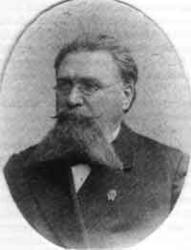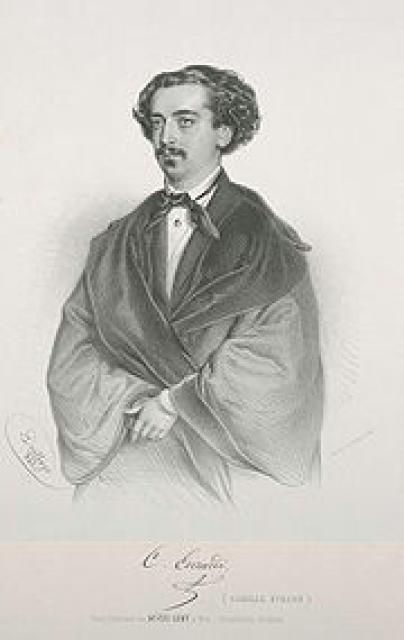
Kamillo Everardi
 Belgium
Biografy of Camillo Everardi
Camillo Everardi was a Belgian singer (baritone) and pedagogue. He was born in Belgium and was the husband of Georgietta Everardi.
Education and Early Career
In 1846, Everardi graduated from the Paris Conservatory. He further perfected his vocal skills in Naples and Milan under the guidance of Francesco Lamperti. In either 1849 or, according to another version, 1850, he made his debut in Giuseppe Verdi's opera "Nabucco" at the San Carlo theater in Naples. From 1851 to 1857, he performed on various opera stages in Europe. In 1857, he sang in Vienna. In the same year, based on the recommendation of the singer Luigi Lablache, he was invited to Russia, to St. Petersburg, where he continued his successful stage career and sang at the St. Petersburg Italian Opera. He became the first performer of the roles of Lord Enrico in "Chatterton" on February 17, 1867, and Mephistopheles in "Faust," in Italian, in 1863. Waldo Pratt's "History of Music" (1907) mentions him among the most outstanding opera singers of his time. He performed bass and baritone roles.
Repertoire
Among the roles he performed were Figaro in Rossini's "The Barber of Seville" (prepared under the guidance of the composer himself), Mephistopheles in Gounod's "Faust" (the composer wrote this role with the voice of Everardi in mind and personally prepared him for it), Don Juan and Leporello in Mozart's "Don Giovanni," Papageno in Puccini's "The Magic Flute," Count Robinson, Assur, Brabantio in Verdi's "Otello," Mustafa in Rossini's "The Italian Girl in Algiers," Fernando and Podesta in "The Thieving Magpie, or The Danger of Judging by Appearances," Malatesta, Count Rodolfo, Richard Fort, Germon, Nevers, and Saint-Brie.
Teaching Career
In 1874, at the height of his artistic powers, Everardi left the stage and dedicated himself to teaching. He became a professor at the St. Petersburg Conservatory from 1870 to 1888, then at the Kiev Music School from 1890 to 1897, and finally at the Moscow Conservatory from 1897.
He trained a whole galaxy of Russian singers, including A.M. Abaza, E. Azerskaya, V. Aleinikov, E. Aleinikov, B. Amirdjan, O. Arsenyeva, L. Arumbasheva, E. Bobrova, M. Bocharov, K. Bragin, M. Budkevich, N. Vekov, Yu. Vishnevetskaya, I. Vulpie, S. Gabel, I. Gordi, A.M. Davydov, P. Davydov, V. Devikler, E. Dore, O. Zambelli, V. Zaryudnaya, L. Zvyagina, E. Ivanov-Smolensky, A. Ivanova-Okulich, O. Kamionsky, E. Koncha, V. Kruzhilina, O. Kuza-Pokassovskaya, F. Levitsky, V. Leminskaya, S. Lensky, P. Lodyi, V. Lossky, M. Lunacharsky, Ya. Lyubin, A. Lyarov, I. Matchinsky, Yu. Mahina, M.I. Melnikov, Yu. Modestov, S. Molchanovsky, G. Monakhov, G. Morsky, E. Nedzvetskaya-Apukhtina, N. Novospasskaya, R. Nouvel-Nordi, L. Obraztsov, E. Pavlovskaia, S. Pavlovsky, M.E. Pyatnitsky, E. Rapoport, R. Romanov-Dobrzanski, E. Ryadnov, N. Salina, V. Samus, E. Serno-Solovievich, E. Silina, Skalkovskaya, M. Slavina, H. Speransky, F. Stravinsky, V. Strakhova, I. Suprunenko, S. Tamarova, I. Tartakov, V. Time, S. Trezvinsky, V. Trubin, N. Unkovsky, D. Usatov, E. Cezar-Inzarova, M. Yunevich, L. Yanikovskaya, and Vladimir Mayboroda.
As noted by Evgeny Nesterenko, Everardi, who was close to Gounod and Rossini, taught a lot in Russia. My first teacher was one of his students, and my professor at the conservatory was also one of his students... And Everardi himself studied under Lamperti and Garcia: that's how the long Italian-Belgian-French-Spanish tradition continues in Russia!