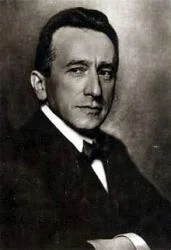
Karel Goeyvaerts
 Belgium
Karel Goeyvaerts (June 8, 1923 – February 3, 1993) was a Belgian composer whose experiments helped shape postwar serial and electronic music. His work ranged from tightly ordered compositions to chance-based and minimalist forms, while his conversations and collaborations with Karlheinz Stockhausen helped spread new ideas through Europe’s avant-garde music scene.
From Antwerp to Paris
Born in Antwerp, Goeyvaerts studied piano, harmony, counterpoint, fugue, composition and music history at the Royal Flemish Conservatory there from 1943 to 1947. He continued his studies at the Paris Conservatoire, where he worked in composition with Darius Milhaud, studied analysis with Olivier Messiaen and learned to play the ondes Martenot from its inventor, Maurice Martenot.
The encounter between his interests in mathematical order and new musical techniques led to *Sonata for Two Pianos* (1950–51), designated his Opus 1. Goeyvaerts and Stockhausen performed its second movement at the 1951 Darmstadt summer courses. The work became a landmark of early postwar serialism, extending strict organization beyond melody to elements such as rhythm, intensity and articulation. Its ideas also influenced Stockhausen’s early compositions.
Exploring electronic sound
Goeyvaerts was among the first composers to explore electronic music. His *Composition No. 4 with Dead Tones* (1952) and *No. 5 with Pure Tones* (1953) applied serial ideas to electronically generated sounds. He and Stockhausen were part of the first generation of composers to create music with electronic generators at the WDR studio in Cologne.
After several years away from public musical life, Goeyvaerts returned to the field in 1970 as a producer at the Institute for Psycho-Acoustic and Electronic Music (IPEM) in Ghent, a center for research and production founded by Belgian public broadcasting and the University of Ghent. He later worked as a producer of new music for Belgian radio in Brussels.
A changing musical language
Goeyvaerts did not remain tied to serialism. His later music explored chance, repetition, new kinds of tonality and a quieter, more meditative character. He regarded serialism and minimalism as different ways to create static musical structures, and his evolving style resisted a simple division between the avant-garde and the accessible.
His late works included the opera *Aquarius*, composed between 1983 and 1992. He was still at work on *Alba per Alban* when he died suddenly in Antwerp in 1993. His career left a distinctive path through the music of the second half of the twentieth century: from rigorous serial systems to electronic sound and the contemplative repetition of his final period.