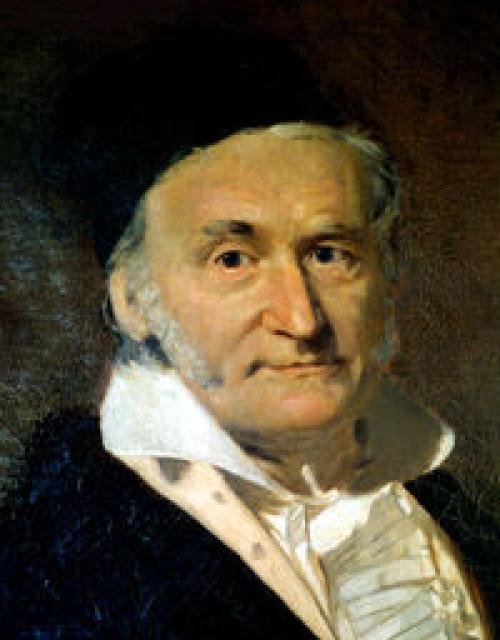
Karl Gauss
 Germany
- Biography of Carl Gauss
- Early Life and Education
- Mathematical Prodigy
- Achievements and Contributions
- Recognition and Legacy
Biography of Carl Gauss
Carl Friedrich Gauss was born on April 30, 1777, in Braunschweig, Germany. He passed away on February 23, 1855, in Göttingen. Gauss was a German mathematician and a foreign corresponding member (1802) and honorary foreign member (1824) of the St. Petersburg Academy of Sciences.

Early Life and Education
Gauss was born into a family of a plumber. He displayed exceptional mathematical abilities from a young age. Between 1795 and 1798, he studied at the University of Göttingen. Upon completing his education, Gauss prepared a groundbreaking work on number theory and higher algebra titled "Disquisitiones Arithmeticae" (published in 1801).
Mathematical Prodigy
Gauss showed remarkable math skills since childhood. At the age of 10, he solved the problem of summing the numbers from 1 to 100, which drew the attention of his teacher. This led to individualized instruction for Gauss in mathematics. On March 30, 1796, he solved the problem of constructing a regular 17-gon, which became a turning point in Gauss's life. It solidified his dedication to mathematics instead of philology.
Achievements and Contributions
Gauss gained worldwide recognition for developing a method to compute the elliptical orbit of a planet using three observations. Applying this method to the minor planet Ceres allowed its rediscovery after it was lost shortly after its initial discovery by Giuseppe Piazzi in 1801. In his fundamental work "The Theory of Celestial Bodies' Motion" (1809), Gauss described methods for calculating planetary orbits that are still used today with minor modifications.
Recognition and Legacy
Gauss was honored as an honorary foreign member of the St. Petersburg Academy of Sciences in 1824. His name is memorialized on the lunar map. Gauss's contributions to mathematics and celestial mechanics established him as one of the most influential mathematicians in history.



