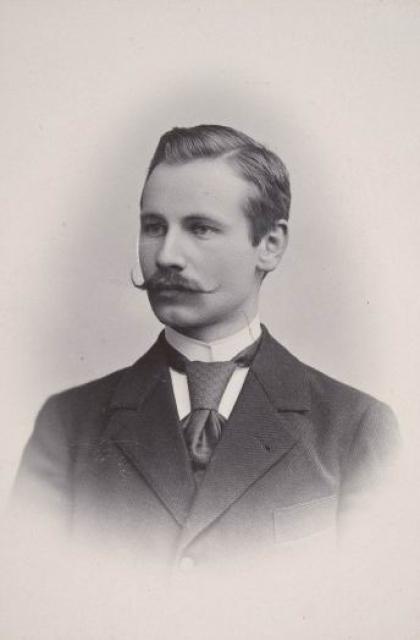
Karl Sundman
 Finland
Karl Frithiof Sundman
Karl Frithiof Sundman, a distinguished Finnish mathematician, was renowned for his groundbreaking contributions to the field of celestial mechanics. His legacy continues to inspire and shape the study of celestial bodies today.
Birth and Early Life
Sundman was born on October 28, 1873, in the town of Kaskö, within the Grand Duchy of Finland, which was then part of the Russian Empire. His exceptional mathematical abilities became evident from a young age, fostering a lifelong passion for the pursuit of knowledge.
Academic Achievements
Sundman's mathematical prowess led him to the University of Helsinki, where he embarked on a brilliant academic career. Between 1906 and 1912, he achieved international acclaim for his seminal work on the three-body problem, formulating a comprehensive analytical solution as a series of convergent sequences. This breakthrough earned him the prestigious 1913 prize from the Finnish Academy of Sciences.
Recognizing his outstanding contributions, the French Academy of Sciences awarded Sundman its own prize in 1913. His reputation as a leading mathematician extended beyond national borders, culminated in his election as a foreign member of the Swedish Royal Academy of Sciences in 1947.
Legacy and Honors
Sundman passed away on September 28, 1949, in Helsinki, leaving an enduring legacy as one of Finland's most prominent scientists. In recognition of his groundbreaking work, a crater on the Moon and an asteroid (1424 Sundmania) were named in his honor, commemorating his invaluable contributions to celestial mechanics.
Sundman's innovative solutions to complex mathematical problems continue to serve as foundations for modern space exploration and astrophysics. His pioneering spirit and relentless pursuit of knowledge inspire generations of mathematicians and scientists alike.