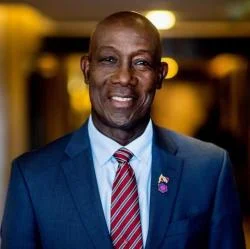
Keith Christopher Rowley
- From Tobago to University
- Entering Public Life
- Prime Minister Through a Difficult Decade
- Resignation and Legacy
Keith Christopher Rowley’s path to the leadership of Trinidad and Tobago began in science. A trained geologist and volcanologist, he spent years in research before entering politics. He later held several ministerial portfolios, led the People’s National Movement and served as prime minister for nearly a decade, guiding the country through economic shifts and the COVID-19 pandemic.
From Tobago to University
Rowley was born on 24 October 1949 in Mason Hall, Tobago, and was raised by his grandparents, who were farmers. He attended Bishop’s High School, where he earned the Sylvan Bowles Scholarship. It enabled him to study at the University of the West Indies in Jamaica, where he graduated with first-class honours in geography and geology.
He went on to complete a master’s degree and a doctorate in geochemistry at the University of the West Indies, St Augustine campus in Trinidad. Rowley became a volcanologist and worked as a research fellow and head of department at the university’s Seismic Research Unit. His research career included providing scientific advice to governments during volcanic emergencies in the Caribbean and other regions.
Entering Public Life
Rowley entered national politics as an opposition senator in 1987. He was later elected to the House of Representatives, representing Diego Martin West, and served through successive parliamentary terms. In government, he held cabinet portfolios including Agriculture, Lands and Marine Resources; Planning and Development; Housing; and Trade and Industry. His scientific background was unusual in a political landscape often dominated by lawyers and career politicians.
In 2010, he became political leader of the People’s National Movement and leader of the opposition. He led the PNM to victory in the 2015 general election and was sworn in as Trinidad and Tobago’s seventh prime minister on 9 September. He won a second term in 2020.
Prime Minister Through a Difficult Decade
Rowley’s first term began amid the fallout from falling energy revenues, a major concern for a country whose economy relies heavily on oil and natural gas. His governments focused on managing public finances and maintaining economic stability while facing pressure over jobs, crime and public services. As prime minister, he also served as head of government during the COVID-19 pandemic, when his administration imposed public health measures and coordinated the country’s response.
His political style was direct and often combative. Supporters viewed him as a decisive leader with deep knowledge of government; critics challenged his handling of economic and social problems. Over two terms, he became one of the most prominent political figures in the country’s modern history.
Resignation and Legacy
Rowley resigned as prime minister on 16 March 2025, and Stuart Young was sworn in the following day. His time in office had spanned two election victories, a period of economic uncertainty and a public health crisis. Before and during that political career, his scientific training remained a defining part of his identity: he was a geologist who moved from studying volcanic hazards to leading a nation through its own tests and disruptions.
Rowley’s career connected academia, public administration and national politics. He entered office as a scientist with extensive parliamentary experience, and left after nearly ten years at the center of Trinidad and Tobago’s government.