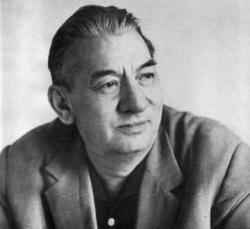
Kenneth Burke
 USA
USABiography of Kenneth Burke
Kenneth Burke was an American writer, journalist, philosopher, literature researcher, and communication theorist. He was particularly interested in rhetoric and aesthetics. He was born on May 5th in Pittsburgh, Pennsylvania, USA. He attended school with the future literary critic Malcolm Cowley. Burke enrolled in Ohio State University but only studied there for one semester. He also did not complete his studies at Columbia University and instead pursued literature. In Greenwich Village, he befriended representatives of the New York avant-garde, including Hart Crane and others.
From 1917, Burke published as a novelist and released a book of short stories in 1924. He published the modernist journal Dial in 1923 and contributed to its section on music criticism from 1927 to 1929. Later, he worked in the same capacity for the newspaper Nation from 1934 to 1936. He translated Thomas Mann's novella Death in Venice in 1924. He had friendships and correspondences with many prominent American writers, such as Marianne Moore, W.K. Williams, R.P. Warren, Ralph Ellison, K.E. Porter, and others. He taught at the University of Chicago, the New School for Social Research, Princeton, and Harvard. He passed away from a heart attack on his farm. Like many other thinkers and critics of the 20th century, Kenneth Burke was strongly influenced by the ideas of Karl Marx, Sigmund Freud, and Friedrich Nietzsche. Throughout his life, Burke engaged in translating Shakespeare and was also influenced by Thorstein Veblen. He corresponded with many literary critics, philosophers, and writers, including William Carlos Williams, Malcolm Cowley, Robert Penn Warren, Allen Tate, Ralph Ellison, Katherine Anne Porter, and Marianne Moore. Thinkers who were influenced by Burke's ideas include Harold Bloom, Stanley Cavell, Susan Sontag (she was his student at the University of Chicago), Edward Said, Rene Girard, Frederic Jameson, and Clifford Geertz. In the US, there is the Kenneth Burke Society, and a journal is published that develops his ideas. Burke did not want to be associated with any particular philosophical or political school of thought. He opposed Marxist ideas that largely determined literary criticism in the 1930s. Political and social symbols occupied a central place in Burke's teachings throughout his career. His interest in politics is evident, for example, in the beginning of "Grammar of Motives", with the epigraph ad bellum purificandum - purification of war, where "the pure" implies the elimination of war. Burke believed that studying rhetoric would help people understand "what is meant when we say that people do things and why they do them." Burke calls this analysis "dramatism" and believes that this approach to language analysis can help understand the foundations of conflicts, the merits and dangers of interaction, and the possibilities of identification. From the 1930s, Burke developed the philosophy of literature within the framework of communication theory as symbolic action. This trilogy of his most famous works (Grammar of Motives, 1945; Rhetoric of Motives, 1950; Language as Symbolic Action, 1966) is devoted to this issue. Burke is associated with the symbolic interactionism school, with E. Goffman; he influenced the development of the dramatic perspective in sociology. Burke defined the rhetorical function of language as a "symbolic means that stimulates interaction in entities that by their nature react to symbols." He defines a "human" as an "animal that makes, uses, and abuses symbols; as a creator of a negative, separated from nature by means made by himself..." In Burke's philosophy, social interaction and communication should be understood within the framework of five elements: act, scene, agent, agency, and purpose. According to Burke, most cases of social interaction and communication should be approached as a form of drama, the outcomes of which are determined by the ratio of these five elements. This became known as the "dramatistic pentad". The pentad is embedded in the dramaturgical method, according to which the relationship between life and theater is understood literally, not metaphorically: for Burke, the whole world is a stage. Burke conducts literary criticism not as something formal, but rather as something that has significant sociological influence. He considered literature as "equipment for living", offering folk wisdom and common sense to people and thus shaping their way of life. Another key concept for Burke is terministic screen - a set of symbols that becomes a kind of screen or grid of availability through which the world makes sense to us. Here, Burke proposes a way to understand the connection between language and ideology. Language does not simply "reflect" reality but also helps to select or change it.
In his book "Language as Symbolic Action" (1966), Burke defines man as a "symbol-using animal". According to him, this definition means that "reality" is really "created for us by the system of symbols". Without our encyclopedias, atlases, and other reference books, we know little about the world that lies beyond our immediate experience. What we call "reality", Burke states, is actually "a disorder of past symbols, combined with things known mostly from maps, magazines, newspapers...". College students, wandering from class to class, from English literature to sociology to biology, encounter a new reality each time they enter a class; the courses listed in the university catalog "have force, they function, but they differ greatly in terminology". Naturally, people who consider themselves Christians and believe in religion as a symbolic system live in a reality different from that of Buddhists, Jews, or Muslims. The same is true for people who believe in the principles of a free market, capitalism or socialism, Freudian psychoanalysis or Jungian depth psychology, as well as mysticism or materialism. Each system of belief has its own vocabulary for describing how the world is structured and what things mean, thus presenting its adherents with a certain type of reality.