Kenneth Snelson
 USA
USA- Kenneth Snelson: American Sculptor and Photographer
- Early Life and Education
- Exploring Photography
- Artistic Career and Achievements
- Co-Founder of "ConStruct"
- The Concept of "Tensegrity"
- Artistic Influences
- Engineering Background
- Later Works
Kenneth Snelson: American Sculptor and Photographer
Kenneth Snelson was an American sculptor and photographer known for his innovative approach to sculpture. His works consisted of flexible and rigid components combined according to the concept of "tensegrity".
Early Life and Education
Snelson was born in Pendleton, Oregon, in 1927. He studied at the University of Oregon in Eugene before attending Black Mountain College from 1948 to 1949. He furthered his studies under Fernand Léger in Paris in 1951. After returning to the United States, Snelson worked as an operator to fund his sculpture projects.
Exploring Photography
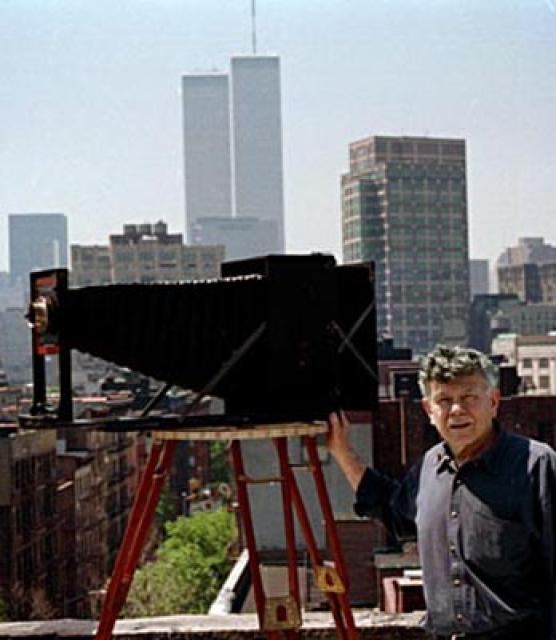
In 1975, Snelson began experimenting with panoramic photography after purchasing a Wide-Lux camera with a 140-degree field of view. In 1983, he started using a Cirkut 16 camera, which allowed him to capture negatives measuring 40x300 centimeters and offered a 360-degree field of view.
Artistic Career and Achievements
Snelson's sculptures and photographs have been exhibited in more than 25 solo exhibitions worldwide. He also conducted research on atomic form. Snelson holds several US patents, including ones for Discontinuous Compression Structures, Model for Atomic Forms, Magnetic Geometric Building System, and Space Frame Structure Made by 3-D Weaving of Rod Members.
Co-Founder of "ConStruct"
Snelson was one of the founders of "ConStruct," a gallery that promoted and organized exhibitions of large-scale sculpture in the United States. Other co-founders included artists such as Mark Di Suvero, John Raymond Henry, Lyman Kipp, and Charles Ginnever.
The Concept of "Tensegrity"
Snelson claimed that his former professor, Buckminster Fuller, appropriated his concept of "tensegrity," which stands for "tensional integrity." Fuller coined the term, combining "tension" and "structural integrity." Geodesic domes, which Fuller advocated for, are structures that rely on this principle. Snelson's sculptures, often delicate in appearance, achieve height and strength through the tension between rigid tubes and flexible cables, using a combination of "push and pull."
Artistic Influences
Snelson's early sculptures, such as "Moving Sculpture" (1948), resembled the balanced structures of Alexander Calder. However, he ultimately gravitated towards the elegant aesthetics of Naum Gabo, the monumental absolute forms of Constantin Brancusi's "Endless Columns," and the innovative concept of structural engineering by Fuller.
Engineering Background
In order to better understand the physical forces at work in complex structures, Snelson took engineering courses at Oregon State College in 1949. This led him to develop a new sculptural aesthetics based on the fundamental forces of tension and compression.
Later Works
While working as an operator from 1952 to 1968, Snelson experimented with a unique form of sculpture in which rigid metal elements were not bolted or welded together but supported by wire. After 1960, he created his characteristic mature works, such as "Sun River" (1967), a gravity-defying self-supporting structure resembling a polished aluminum tube crystal connected by stainless steel cables. By the late 1960s, Snelson gained wide recognition and received numerous commissions for large-scale outdoor sculptures, including the 18-meter "Needle Tower" (1968).
Kenneth Snelson currently resides in New York City with his wife, Catherine.