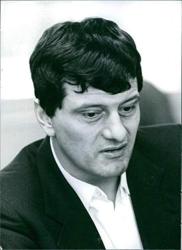
Klaus Venda
 Austria
- A student drawn to chess problems
- A pioneer of modern retro problems
- Service to the chess-composition world
- A lasting creative legacy
Klaus Wenda was an Austrian chess composer whose work ranged from classical multi-move problems to fairy chess and intricate retrograde puzzles. A lawyer by profession and a leading organizer of the international problem-chess community, he helped bring new life to the Anticirce form of retro problem. His compositions, books and editorial work made him influential across several branches of the art, and in 2010 he received the title of Grandmaster of Chess Composition.
A student drawn to chess problems
Wenda was born on 13 September 1941 and grew up in Vienna. As a schoolboy he was already drawn to the riddle-like quality of chess problems, but his serious involvement began at 18, when he was studying law. He joined the circle of Viennese problemists around Josef Halumbirek and absorbed the ideas of the New German school, known for logically constructed problems in which a solution unfolds through carefully prepared variations.
Wenda’s interests soon widened beyond traditional multi-movers. He composed selfmates, fairy chess problems and retros, in which the solver works backward from a position to reconstruct legal play. He became especially interested in fairy conditions such as Madrasi and Circe, where pieces gain unusual powers or are reborn after capture. He enjoyed exploring how a small change in a rule could transform a position’s logic.
A pioneer of modern retro problems
From 2001 onward, Wenda devoted significant energy to defense retractors under the Anticirce condition. These problems ask the solver to retract moves while respecting special capture rules; Wenda’s work helped show how rich and flexible the form could be. His essay “Beckmesser versus Stolzing,” published in the magazine feenschach in 2001, drew the attention of other composers and encouraged a wider wave of experimentation. Fellow problemists later credited his ideas with helping establish modern Anticirce retro problems as a major creative field.
His influence came not only from composing. Wenda wrote and edited books and articles, served as a respected judge of composition tournaments and worked to preserve specialist publications. With Friedrich Chlubna he co-authored the Problempalette anthologies; with Chlubna and Alois Johandl he produced Dreiklang, a collection representing the work of all three composers. He also served as a prominent contributor and mentor to feenschach, a journal devoted to fairy chess and related forms.
Service to the chess-composition world
Wenda balanced this activity with a demanding legal career, eventually leading the legal department of a major Austrian bank. He also took on international service in chess composition. From 1968 he represented Austria in the Permanent Commission of the FIDE for Chess Composition, later known as the WFCC. He was the commission’s president from 1986 to 1994 and subsequently served as honorary president of its successor organization. Colleagues valued his legal judgment, diplomacy and ability to bring people together, as well as his artistic skill.
He was awarded the title of International Judge for Chess Composition in 1968 and became a composition grandmaster in 2010. Wenda continued to support composers and publications throughout his later years, including mentoring efforts to keep feenschach alive.
A lasting creative legacy
Wenda died in Vienna on 11 April 2026, aged 84. Fellow composers remembered him as a versatile artist, a thoughtful organizer and a generous mentor. His legacy is visible in the many problems he composed, but also in the forms he helped popularize, the books and journals he supported, and the international community he served. In a field where each position is a compact argument made with pieces and rules, Wenda’s work showed how much invention can be contained within the 64 squares.