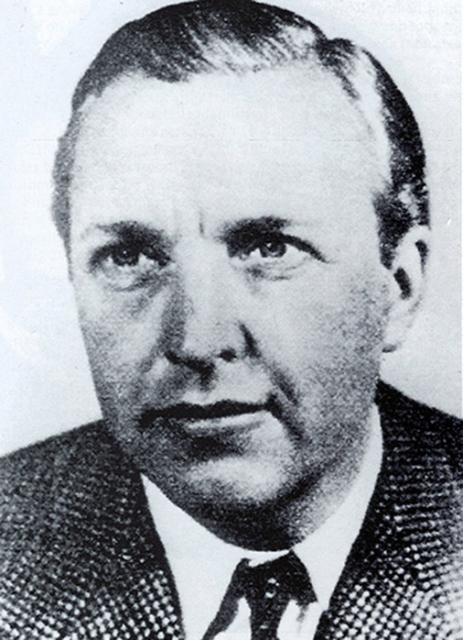
Kurt Becher
 Germany
- Biography of Kurt Becher
- Activities during World War II
- The Kastner Affair and Aftermath
- Kurt Becher died a wealthy man.
Biography of Kurt Becher
Kurt Andreas Ernst Becher was born into a wealthy family on September 12, 1909. He became involved with the SS in 1932 due to his participation in horse racing, and his instructor advised him to voluntarily join the SS cavalry regiment (Reiter-SS) in 1934. Becher served as a major in the SS organization 'Totenkopfverbände' ('Death's Head'), responsible for guarding concentration camps and improving methods of killing Jews. He was appointed by Heinrich Himmler as the commissioner of all German concentration camps and the head of the SS economic department in Hungary during the German occupation in 1944.
Activities during World War II
As the head of the SS economic department, Becher was tasked with extracting maximum economic benefit from Jews, including confiscating their goods and property, selling or using their belongings and even body parts. He claimed to be the main horse buyer for the SS and was sent to Hungary in March 1944 to acquire 20,000 horses. However, it is doubted whether this story is true. Upon arriving in Budapest, Becher immediately began negotiations with leaders of several major Jewish conglomerates, indicating that he was involved in extortion in an attempt to extract as much money as possible from Hungarian Jews on behalf of SS leader Heinrich Himmler.
During the period from 1944 to 1945, Becher amassed a significant amount of money, jewelry, and precious metals. His wealth was estimated at 8,600,000 Swiss francs. He transported most of his fortune, known as the 'Becher Deposit', in six large suitcases. In January 1945, he was appointed by Himmler as the Reich Commissioner for all concentration camps. Becher was arrested by members of the anti-Hitler coalition in May 1945 and imprisoned in Nuremberg. However, he was not prosecuted as a war criminal but merely testified as a witness during the Nuremberg Trials. It was revealed that Becher was responsible for organizing the emigration of Jews from occupied territories to neutral countries.
The Kastner Affair and Aftermath
Rudolf Kastner, one of the leaders of the Hungarian Aid and Rescue Committee, negotiated with the Nazis for the ransom of Jews. He defended Becher at the Nuremberg Trials, resulting in Becher's acquittal. Kastner himself was later killed, supposedly by Israeli intelligence services, in March 1957. The 'Becher Deposit' was eventually sold for only $55,000, much less than its initial value. This was partly due to hyperinflation, which rendered the Hungarian pengo worthless after the war. Additionally, Hungarian officials confiscated a large portion of funds from Jews, including foreign currency. Therefore, the 'Becher Deposit' mainly consisted of jewelry, gold, platinum, precious stones, and other valuables.
After the war, Becher became a successful businessman in Bremen. He held the position of president in numerous corporations, including the 'Cologne-Handel Gesellschaft', which conducted significant business with the Israeli government. By 1960, he had become one of the wealthiest individuals in West Germany, with assets estimated at around $30 million. In 1961, Becher gained public attention again as a witness in the trial of SS officer Adolf Eichmann in Jerusalem. However, he provided his testimony from his home in Germany and refused to travel to Israel.


