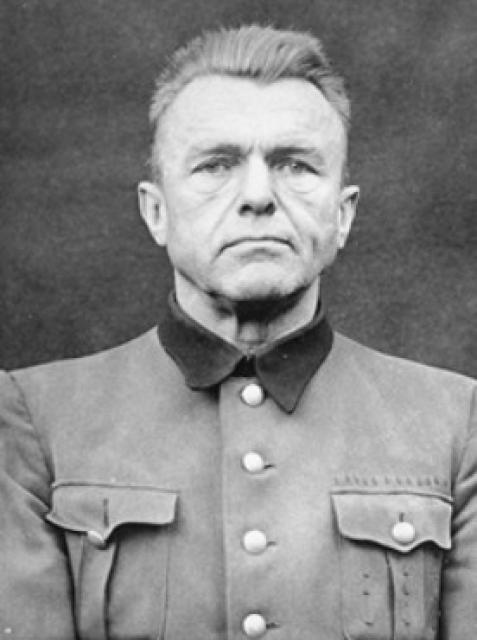
Karl August Genzken
 Germany
Biography of Karl August Genzken
Karl August Genzken was a German doctor and one of the leading medical figures of the Third Reich. He served as the head of the Waffen-SS medical service and held the rank of SS-Gruppenführer. Genzken was also one of the fascist doctors accused in the Nuremberg Doctors' Trial.
Born in Preetz, Genzken completed his secondary education there. In 1905, he graduated from the gymnasium in Kiel and began studying medicine at various universities, including Kiel, Marburg, Munich, and Tübingen. From 1912 to 1919, Genzken served in the medical service of the Imperial German Navy as an officer. During this time, he provided medical assistance to submarine crews and also worked in the departmental hospital in Wilhelmshaven. His activities during World War I were recognized with the Iron Cross, first and second class.
After the war, Genzken opened a medical practice in Preetz in 1919 and worked as a general practitioner until 1934. Over time, he became interested in the Nazi movement and joined the Nazi Party (NSDAP) in 1926 and the SS in 1933. In 1934, Genzken decided to leave his medical practice and offer his services as the party's doctor. On February 1, 1937, he was appointed the leader of the SS division "Totenkopf," which included doctors in concentration camps. It was under Genzken's leadership that forced sterilization was introduced in the concentration camps to enforce the "Law for the Prevention of Hereditarily Diseased Offspring." He also approved the experiments on sterilization and castration conducted by psychiatrist Werner Heyde from Würzburg.
Genzken held the position of Chief Medical Officer of the SS from April 1940 until the end of World War II. At the Nuremberg Doctors' Trial, which took place from December 9, 1946, to August 20, 1947, he was convicted of war crimes, crimes against humanity, and membership in a criminal organization. According to the initial sentence, he was to remain imprisoned for the rest of his life. However, on January 31, 1951, his sentence was reduced to twenty years, and on April 17, 1954, Genzken was released early. He passed away on October 10, 1957, in Hamburg, West Germany.