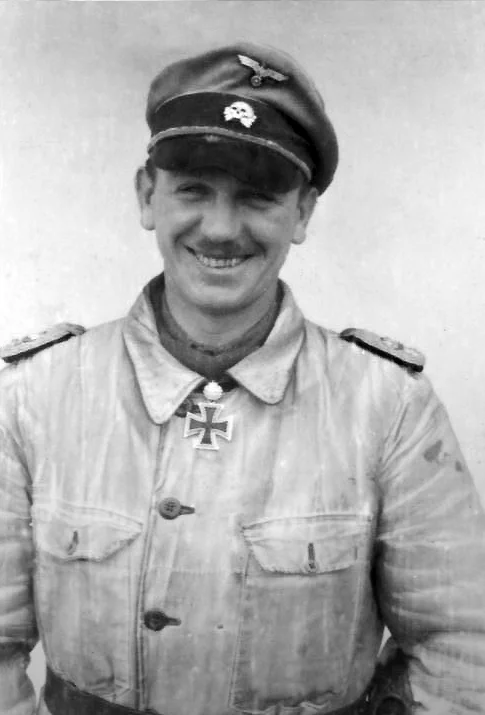
Kurt Meyer
- Childhood and Political Beginnings
- Military Career and Rapid Advancement
- Normandy and the Killing of Prisoners
- Release and Postwar Activities
- Legacy
Born in Jerxheim on 23 December 1910, Kurt Meyer rose from a working-class background to become one of the youngest and most conspicuous commanders in Nazi Germany’s Waffen-SS. His battlefield reputation was built on speed and aggression; the same career ended in a war-crimes conviction for his responsibility in the killing of Canadian prisoners of war.
Childhood and Political Beginnings
Meyer grew up in a working family. He joined the Hitler Youth in 1925, entered the Nazi Party in 1930, and became a member of the SS in 1931. These were deliberate early commitments to the Nazi movement, years before the outbreak of the Second World War. He worked in the Mecklenburg state police before transferring in 1934 to the SS Verfügungstruppe, the armed formation that would become part of the Waffen-SS.
Military Career and Rapid Advancement
Meyer served with the Leibstandarte SS Adolf Hitler, a unit closely tied to Hitler and the Nazi leadership. During the 1939 invasion of Poland, he commanded a reconnaissance unit. He continued to rise through the ranks in the campaigns in Western Europe and the Balkans. In 1941, he received the Knight’s Cross for actions in Greece, including the capture of the Klisura Pass and the crossing of the Gulf of Patras.
He later fought on the Eastern Front, where he commanded a regiment in the 1st SS Panzer Division. In 1943 he took command of the 25th SS Panzergrenadier Regiment in the newly formed 12th SS Panzer Division, known as Hitlerjugend because many of its young recruits came from the Hitler Youth. Meyer’s leadership style was associated with rapid, forceful attacks, and Nazi Germany decorated him repeatedly. Those honors reflected the regime’s military priorities; they do not lessen the record of crimes committed by his forces.
Normandy and the Killing of Prisoners
The division was sent to Normandy after the Allied landings in June 1944 and fought Canadian forces near Caen. Canadian and other Allied prisoners were murdered by members of the division during the campaign. Meyer was appointed divisional commander after Fritz Witt was killed in June.
A Canadian military court tried Meyer at Aurich, Germany, from 10 to 28 December 1945. The case examined his command responsibility and his conduct toward prisoners. He was convicted on three of five charges, including responsibility for killings of Canadian POWs and an earlier charge relating to an order or encouragement to deny quarter. The court sentenced him to death. The findings concerned his own responsibility under the charges; they should not be read as a court ruling that he personally carried out every killing attributed to the division.
The sentence was commuted to life imprisonment, and Meyer was transferred to Dorchester Penitentiary in Canada. His case remained contentious: the trial raised difficult questions about how far a commander could be held responsible for crimes carried out by subordinates, while the murder of prisoners under his command formed the core of the prosecution.
Release and Postwar Activities
Meyer was released in 1954 and returned to West Germany. He worked as a brewery representative in Hagen and became a leading spokesman for HIAG, an organization of former Waffen-SS members that campaigned for their rehabilitation and sought to recast the organization’s record. Meyer’s postwar public role thus continued the struggle over how the Waffen-SS and its members would be remembered.
He also published a memoir, Grenadiere, in 1957, presenting his wartime experiences from his own perspective. As a former commander and convicted war criminal, his accounts and advocacy need to be read against the established record of crimes by Waffen-SS forces, including the killings for which he was convicted.
Legacy
Meyer died in Hagen on 23 December 1961, his fifty-first birthday. He remains a prominent example of the young commanders elevated by the Nazi military system and of the postwar campaigns to rehabilitate the Waffen-SS. His decorations and battlefield reputation cannot be separated from his political allegiance, his command of a division implicated in prisoner killings, and his conviction by a Canadian military court.