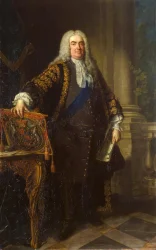
Auguste de Marmont
- An artillery officer and Napoleon’s aide
- Marshal in the Napoleonic wars
- Restoration, revolution, and exile
- A complicated legacy
Auguste de Marmont rose from artillery officer to one of Napoleon’s marshals, serving the French Empire across Europe. A close companion of Napoleon from the Italian campaigns onward, he later became known above all for changing sides during the collapse of the Empire in 1814. The decision earned him the enduring label of traitor in France, even as his long military career included major commands and administrative service.
An artillery officer and Napoleon’s aide
Auguste-Frédéric-Louis Viesse de Marmont was born on 20 July 1774 in Châtillon-sur-Seine, France. The son of a former army officer, he studied mathematics before entering artillery school at Châlons. He met Napoleon Bonaparte during the Revolutionary Wars and became one of his aides-de-camp. Marmont accompanied him to Italy and Egypt, gaining promotion and a place in the inner circle of the future emperor.
He took part in the coup of 18 Brumaire in 1799, which brought Napoleon to power, and directed artillery at the Battle of Marengo in 1800. He later commanded an army corps and served as governor in Dalmatia. After French forces took Ragusa, now Dubrovnik, Marmont received the title Duke of Ragusa in 1808. His experience as an administrator in Dalmatia and the Illyrian Provinces added a civilian dimension to a career otherwise defined by military campaigns.
Marshal in the Napoleonic wars
In 1809, Marmont fought in the campaign against Austria and was made a Marshal of the Empire. He later commanded French forces in Portugal and Spain during the Peninsular War. His army maneuvered effectively in several operations, but at Salamanca in July 1812, Wellington’s forces dealt the French a serious defeat. Marmont was badly wounded and left the field; Napoleon later gave him another corps command after his recovery.
Marmont fought in the German campaigns of 1813 and in the defense of France in 1814. As Allied forces approached Paris, he helped defend the capital’s outskirts before withdrawing with his corps to Essonne. With Napoleon’s position collapsing, Marmont entered negotiations with the Allies and transferred his troops to their side. The move helped make Napoleon’s continued rule untenable and contributed to his abdication.
The decision was seen by Napoleon and many French observers as a betrayal. Marmont argued that he had acted to end a hopeless war and protect France. The word “raguser,” derived from his title, entered French usage as a term for betrayal. The controversy followed him for the rest of his life and overshadowed his earlier service.
Restoration, revolution, and exile
Under the restored Bourbon monarchy, Marmont received high office and was made a peer of France. He remained in royal service after Napoleon’s return during the Hundred Days, and Napoleon removed him from the list of marshals. In 1830, as commander of the royal forces in Paris, Marmont was ordered to suppress the July Revolution against Charles X. His troops could not hold the capital. Marmont had urged the king to withdraw the July Ordinances that had triggered the revolt, but after the monarchy fell he accompanied Charles into exile.
Marmont spent his later years outside France, including a period in Vienna, where he met the Duke of Reichstadt, Napoleon’s son. He wrote extensive memoirs defending his actions and recording the campaigns he had witnessed. They remain useful sources, though they must be read as the work of a participant eager to justify his decisions. Marmont died in Venice on 3 March 1852.
A complicated legacy
Marmont’s reputation was shaped by two dramatic political crises: the transfer of his corps to the Allies in 1814 and his failure to save the Bourbon monarchy in 1830. He had been a loyal imperial commander, a capable artillery officer, and an administrator, but his choices at the end of Napoleon’s rule became the defining story told about him.