
Kye Vincent
 Great Britain
- A Brave Fighter: The Biography of Kai Vincent
- The Beginnings of Trials
- But the next morning, Kai simply couldn't get down from his bunk bed.
- A Battle for Survival
- However, during the same procedure, the patient lost his left hand.
- Symptoms of Meningitis and Sepsis
- - Fever is often absent in children under three months old
A Brave Fighter: The Biography of Kai Vincent
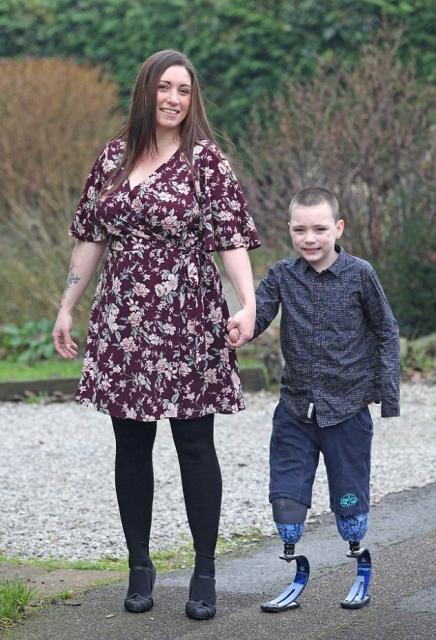
Little boy who lost his legs and one of his hands due to meningococcal sepsis, has learned to walk again - thanks to prosthetic limbs. Now eight years old, Kai Vincent became a victim of meningococcal sepsis, despite having received the vaccine earlier. The infection severely affected Kai's condition, forcing doctors to put him into an induced coma to increase his chances of survival. While Kai's body fought against meningitis, the bacteria still reached his limbs, resulting in the amputation of his legs and one hand. Nevertheless, this little fighter managed to overcome it all. Today, he eagerly awaits Christmas in his specially adapted home. Cheryl Vincent, Kai's 36-year-old mother from Leighton Buzzard, Bedfordshire, said: "Kai is the bravest person I know. There were times when we thought we might lose our son. But he is a warrior. He did not let his disability break him." "I am so glad I noticed the early signs of the illness and called for an ambulance. If I had waited a little longer, my son might not be here today." "Recently, Kai has learned to write again. For the past two days, he has been attending school. Now we call him 'Kye-Vinceable.' He is our little miracle."

The Beginnings of Trials
The trials for Kai Vincent began in March 2016 when he complained of headaches and felt nauseous. He also had a high fever. His experienced grandmother, who had visited the family, suspected meningitis. However, Kai only had three of the main symptoms of the infection, so for a while, his family believed he had just caught a virus.

The boy was given medication and sent to bed. Cheryl called a doctor who advised her to monitor Kai's temperature constantly and keep him in a cool room with a slightly open window.
But the next morning, Kai simply couldn't get down from his bunk bed.
His mother recalls, "He called me and his dad Luke from the bedroom. Our son told us that he couldn't move his legs." "When Luke lifted him from the bed and tried to put him on the floor, Kai's legs gave way. When we told our son to walk, he said he couldn't feel his legs and couldn't move them."

Father, 27-year-old Luke Baxter, noticed four dark purple bruises on Kai's shoulders, knees, and thighs. These clusters felt cold to the touch.
The parents immediately realized that the bruises were a symptom of meningitis and called emergency services.
An ambulance arrived in 10 minutes; Kai was given antibiotics before being taken to the Luton and Dunstable Hospital.
Cheryl said, "When we arrived, a large team of medics was already waiting for us. They put our son on a drip and took his blood." "It was awful. We watched as bruises continued to appear on our little boy's body." "Within three hours, he looked like a victim of beatings. He was screaming in agony."
A Battle for Survival
Soon, the boy was diagnosed with meningococcal sepsis. He was put into a coma to help his body fight the severe infection.
This bacterial infection causes inflammation of the membranes covering the brain and spinal cord. Sepsis develops as a result of the bacteria entering the bloodstream.
After three days, Kai's hands and feet started to darken. The patient was in critical condition.
Cheryl remembers, "I whispered to my son's ear while he was in a coma. I told him that he needed to fight and that I would rather go through all of this myself." "I told him how much I missed his voice and my motherly duties."
After six weeks, the boy was brought out of the coma. But the doctors stunned his parents when they announced the need to amputate Kai's legs and one hand.
"When I was told about everything, I just broke down," Cheryl said. "The next day, when I sat next to my son with a child psychologist, I had to break the horrible news to him." "He cried, 'Mommy, don't take away my legs.' And that was the most heart-wrenching moment of my life."
In April 2016, a three-hour operation resulted in the amputation of Kai's legs; his right leg was removed above the knee, and his left leg below the knee.
A few days later, the boy opened his eyes, turned to his mother, and said, "Look, mommy, it's easier for me to move now. I have less pain."
The following month, a procedure was performed to remove dead tissue from his right hand. After the skin had healed, surgeons were able to reconstruct his thumb and leave three stumps from his fingers.
However, during the same procedure, the patient lost his left hand.
New Beginnings and TriumphsVincent spent six months in a hospital room before being transferred to Stoke Mandeville Hospital for rehabilitation and physiotherapy.
Since then, he has learned to walk with the help of prosthetics, and he excels at it.
In December 2016, the family moved into a home equipped with an elevator that takes Kai to his bedroom. Additionally, the space in the house is arranged to allow the boy to move freely.
Doctors are still trying to determine why Kai Vincent's body, which was vaccinated against meningitis C in infancy, failed to produce antibodies to fight the disease.
Symptoms of Meningitis and Sepsis
- Fever and/or vomiting- Severe headache
- Joint, muscle, or limb pain
- Cold hands and feet or tremors
- Pale or mottled skin
- Rapid breathing or a sense of "not getting enough" air
- Rash on any part of the body
- Stiff neck muscles (less common in young children)
- Dislike of bright lights (less common in young children)
- Excessive sleepiness, indifference, and difficulty waking
- Confusion or delirium
- Seizures or fits
- Tense or bulging fontanelle (soft spot on the baby's head)
- Refusing to feed; being irritable when picked up, resulting in a sharp cry or whining
- Body appearing stiff and movements jerky, or limp-like body, as if lifeless
- Fever is often absent in children under three months old
Sepsis can develop separately or together with meningitis. Not all symptoms may be present, and they can appear in any order.


