Lady Godiva
 Great Britain
- Lady Godiva - Biography
- Philanthropy and Religious Contributions
- Generosity and Legacy
- Legacy and Legends
- Legacy and Commemorations
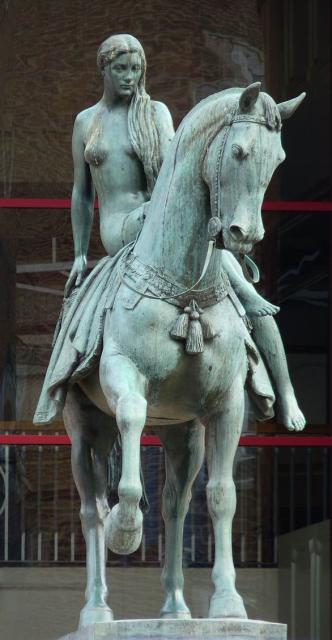
- A monument to Lady Godiva was erected in the Coventry city park.
Lady Godiva - Biography
Early Life and MarriageLady Godiva was an Anglo-Saxon noblewoman who, according to legend, rode through the streets of the British city of Coventry on a horse, naked, only covered by her long hair. She was the wife of Leofric, the Earl of Mercia, a powerful magnate in Anglo-Saxon Britain. The couple had a son, Aelfgar, who became the Earl of East Anglia.
Philanthropy and Religious Contributions
Leofric and Godiva were known for their generous donations to religious institutions. In 1034, Leofric founded and supported a Benedictine monastery in Coventry, replacing the one destroyed by the Danes in 1016. In 1050, Godiva's and Leofric's names were recorded in documents granting land to the monastery of St. Mary in Worcester. Godiva also gifted several precious metal works made by the renowned goldsmith Manning to Coventry, and bequeathed a silver necklace worth 100 marks to the city. Another necklace was given to Evesham. St. Paul's Cathedral in the City of London received church vestments with a golden fringe from Godiva.
Generosity and Legacy
The couple was among the most generous benefactors among the major Anglo-Saxon landowners in the last decade before the Norman Conquest of England. However, early Norman bishops confiscated the gifts of Leofric and Godiva, taking them to Normandy and melting them down into bars. After Leofric's death in 1057, Godiva continued to live between 1066 and 1086. She is mentioned in the 'Domesday Book', a compilation of materials for a comprehensive land survey in England, as one of the few Anglo-Saxons and the only woman who remained a major landowner after the Norman Conquest of England.
Legacy and Legends
The exact burial place of Godiva remains disputed. The Oxford National Biography Dictionary states, "There is no reason to doubt that she was buried with her husband in Coventry, despite the assertion of the Evesham Chronicle that she rests in the church of the Holy Trinity in Evesham." The earliest records of the legendary naked equestrian Godiva date back to the 13th century. According to the legend, Lady Godiva had compassion for the people of Coventry, who were burdened with excessive taxes imposed by her husband. She repeatedly pleaded with Leofric for mercy, but he refused to reduce the taxes.
One day, an intoxicated Leofric declared that he would grant Godiva's request if she rode naked through the streets of the city. He was confident that his wife would never agree to such a desperate act. However, Godiva caught him by surprise and accepted the challenge. The citizens were ordered to remain indoors and close their shutters while Lady Godiva rode through the city, only covering her modesty with her long hair. Only one person, a tailor who later became known as Peeping Tom, disobeyed the order. According to the legend, he made a hole in his shutter to catch a glimpse of the naked lady and was immediately blinded. After Godiva's ride, her husband was forced to fulfill his promise and abolish the burdensome taxes.
There are various explanations and interpretations of the Godiva legend, including pagan rituals related to fertility and comparisons to the young "May Queen" who headed towards the sacred tree of Cofa to celebrate the spring renewal. Another attempt to find a more acceptable explanation for the legend relates to the practice of public penance, where a repentant sinner had to undertake a public procession wearing a sleeveless white shirt, considered underwear at that time. Therefore, Godiva likely rode through the city as a penitent sinner, not completely naked. It is likely that the story was later idealized by the people.
Another version of the legend was presented by Richard Grafton, a printer who later became a member of the Coventry Parliament. According to his work, the "Chronicles of England" from 1569, Leofric himself exempted the townsfolk from all taxes except for the horse tax. Godiva agreed to ride naked through the city to free the people of Coventry from the last duty.
Throughout history, different versions of the legend have emerged, including a curious tailor who, overcoming his fear, took a peek at Godiva. However, it is noted that Godiva was not completely naked but dressed in silk tightly fitting her body, with the color resembling her skin tone.
According to the records in the "Domesday Book," Coventry was a small settlement consisting of only 69 families at the time when the Anglo-Saxon lady helped her subjects. The story seems particularly unlikely because Godiva herself dictated the establishment of taxes and levies in Coventry.
Legacy and Commemorations
In 1586, the city of Coventry commissioned a painting by the South Netherlandish artist Adam van Noort, depicting Lady Godiva. He preferred to portray her in a "seductive" manner against the backdrop of a "fantastical Italianized Coventry." The painting was displayed in the main square of the city.
A monument to Lady Godiva was erected in the Coventry city park.
The chocolate company "Godiva Chocolatier," founded in Belgium in 1926, was named after Lady Godiva.
The name "Godiva" is derived from the Latinized Old English "Godgifu," meaning "God's gift."