Laki Luchiano
 Italy
ItalyBiography of Lucky Luciano
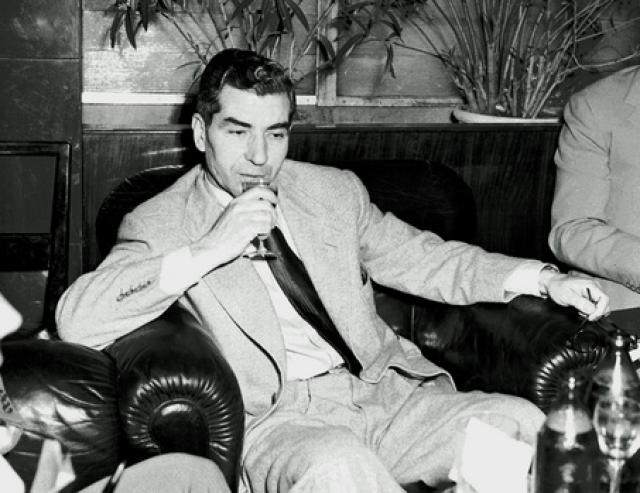
Salvatore Luciano, commonly known as Lucky Luciano, was an American gangster who devoted his attention to business more than others. He was the initiator of the special division "Murder, Inc." in the mafia. Luciano was born on November 24, 1897, in Lercara Friddi, Sicily. He was the third child and second son of Antonio Luciano and his wife Rosalia Capporelli. He was different from his older siblings Giuseppe, Francesca, and his younger brother Bartolo. His mother adored the young Salvatore. In 1907, in an effort to escape poverty, Antonio Luciano left for the United States to find work and save money to bring his family over. After two years, in April 1909, the whole family moved to the U.S. and settled in the Lower East Side.
In his youth, Luciano worked as a laborer for low wages. His father also worked as a miner in a coal mine. The future boss of the "Cosa Nostra" lived in the same neighborhood of Little Italy in New York City as John Torrio and Al Capone. After finishing school, he became friends with Meyer Lansky and Bugsy Siegel, whom he would remain close with for the rest of his life. Later, he met Frank Costello during an operation when Luciano clashed with a gang working on 104th Street. The conflict was resolved after a conversation with their boss, Francesco. Frank was accompanied by his brother Eddie and the teenager Willie Moretti (the life of the party). Also with them was the Englishman Owney Madden. On June 25, 1911, the Ministry of Education placed Salvatore Luciano in one of Brooklyn's institutions for the rehabilitation of troubled teenagers. Later, he met Max Goodman, a maker of women's hats. Max took a liking to the charming young man and hired him as a courier. He paid him a little more than the others and invited him to lunch. Eventually, when Luciano became an unquestioned authority figure, he would not take taxes from Goodman, while protecting him as if he were his own father.
While still working for Goodman, young Salvatore accepted an offer from George Scoplon, who had acquaintances in both the police and political arenas, to deliver drugs. Luciano carried out his task by hiding the drugs in women's hats he delivered to customers. In early June 1916, he was arrested at a billiard hall on 14th Street while attempting to deliver drugs. On June 26, he was sentenced to just one year in the Hampton Faris Reformatory. However, after six months, he was released for exemplary behavior.
The rise of Charlie Luciano to the pinnacle of organized crime began with a difficult path as an ordinary gangster, who were plentiful throughout America at the time. His criminal activities included extortion, robbery, drug trafficking, organizing underground gambling houses, pimping, smuggling, and many other types of criminal activities that could amass a fortune and earn respect. Initially, he was just a low-ranking member of Giuseppe Masseria's "family," one of the two largest gangs in New York City. At the time, a war was raging between Masseria and Maranzano for control of the city.
In 1929, in the center of New York City at the corner of 50th Street and 6th Avenue, he was forced into a car. Luciano was taken from Manhattan to Staten Island and on one of the deserted highways, they tied him to a tree and burned his face with lit cigarettes. These were Maranzano's men attempting to extract the whereabouts of the drugs from Charlie, but he didn't say anything. The gangsters thought he was dead and left him on the road without signs of life. A passing patrol picked up Charlie and took him to the hospital, where he received 55 stitches. He survived. His close friend Meyer Lansky nicknamed Luciano "Lucky." Discovering the location of the hidden drugs was just a clever pretext. In reality, these were Maranzano's men, bought by Masseria, to involve "Lucky" in the war against Maranzano.
But this incident demonstrated two positive traits of Luciano's character. Firstly, he remained silent and did not break during the torture. Secondly, he showed composure towards his tormentor. He analyzed the situation, weighing all the pros and cons, and concluded that his tormentor was not Maranzano but Masseria. The retribution did not take long, and in April 1931, with the help of Maranzano's men, "Lucky" eliminated Masseria, paving the way for unlimited power over the entire world.
Luciano had great organizational skills and a sense of novelty. He came up with a fictitious company as a front for bootlegging. He was one of the first to realize that the mafia should function like a corporation. He organized "The Commission" – a super-cartel of gangsters involved in the sale of alcohol. The junior partners were "New York Independence" and the "Independent Bootleggers of New York," the gangster group led by Siegel and Lansky, as well as smuggling groups from New York, Boston, Rhode Island, and Atlantic City.
Luciano was known as the "most intellectual criminal in the world." In his book "The Mafia in the U.S.," Robert Ivanov writes: "Luciano's mistake was that he associated with non-Italian criminals. Another mistake was treating Jews as equals. They even made more profit than Sicilians in "The Commission." However, this could only be claimed if he had significantly lost authority in front of the bosses of other "families." But that did not happen. No one could dispute the recognized authority of "Cosa Nostra." It was not Luciano's mistake but a revolutionary innovation of his time. Now, "Cosa Nostra" employed not only Sicilians but also those who were needed by this great organization. It is worth noting that non-Italian gangsters worked for "Cosa Nostra," but they did not have the right to join its ranks and become full-fledged members. This firm rule still holds true today.
Luciano, more than others, focused on the business side of things. He was the first to realize that division of labor would increase the efficiency of the mafia. He initiated the special division of "Cosa Nostra" called "Murder, Inc." and recommended Albert Anastasia to lead it.
Luciano took control of prostitution and became the number one pimp. He owned around 200 brothels in New York City. In 1935, his income from prostitution was around $20 million, of which he personally received $200,000.
Thomas Dewey decided to put Luciano behind bars and organized a secret operation. At 8 p.m., the police raided 40 brothels. Around 120 people were arrested, and accounting books were seized. Only one witness began to talk - prostitute Nancy Presser.
Luciano was sentenced to 50 years.