Leo the Mathematician
 Italy
Italy- Biography of Leo the Mathematician
- Early Life and Education
- Teaching Career
- Archbishop of Thessalonica
- Later Life and Contributions
Biography of Leo the Mathematician
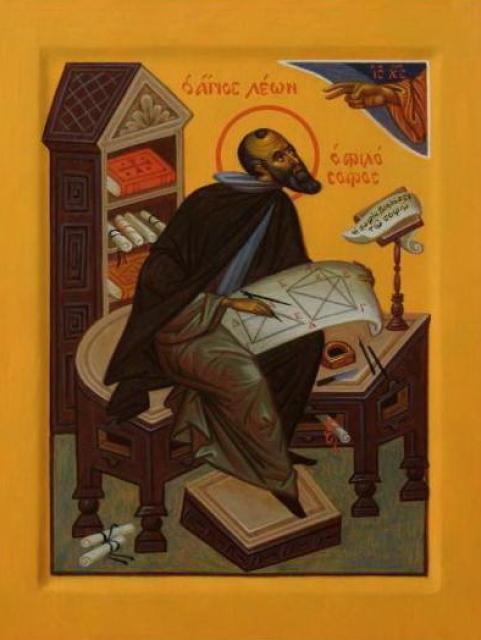
Leo the Mathematician, also known as Leo the Philosopher, was a Byzantine philosopher and logician during the Macedonian Renaissance and the end of the Byzantine Iconoclasm. Although many of Leo's works have been lost over time, we can judge his talents and accomplishments based on the records of his contemporaries and historical writings.
Early Life and Education
Leo was born in Thessaly and was a cousin of John the Grammarian, the Patriarch of Constantinople. In his youth, Leo studied in Constantinople for a while before embarking on a journey. During his travels, he discovered rare manuscripts and received mathematical lessons from an elderly monk in the monasteries of Andros.
Teaching Career
For some time, Leo secretly gave private lessons in Constantinople, but he did not gain much popularity. According to legend, his fame came after one of his students was captured by the caliph al-Mamun during the Byzantine-Arab wars. Impressed by the mathematical knowledge of the captive, the caliph invited Leo to Baghdad, promising him immense wealth. Leo presented the caliph's letter to the Byzantine Emperor Theophilos, which greatly impressed him. As a result, Leo was offered the position of heading a school either in Magnaura or at the Church of the Forty Martyrs.
Archbishop of Thessalonica
According to the legend recorded in 'Theophanes Continuatus', after receiving a letter from Leo declining the caliph's invitation, the caliph sent several challenging geometric and astrological problems. Leo brilliantly solved these problems, and the caliph offered Emperor Theophilos two thousand pounds of silver and eternal peace in exchange for borrowing Leo for a while. However, the emperor refused. Shortly after this, Theophilos appointed Leo as the Archbishop of Thessalonica, a position he held from spring 840 to 843. It is likely that there is an error in this part of the legend, as the caliph passed away in 833.
Later Life and Contributions
Despite being a staunch iconoclast and even being accused of paganism, Leo delivered a significant sermon in favor of icons around the time of his benefactor Theophilos' death. With the end of the Byzantine Iconoclasm, Leo lost his position. Around 855, he became the head of the newly established Magnaura School. As the head of the school, Leo had the opportunity to demonstrate his exceptional knowledge in philosophy, mathematics, medicine, literature, philology, astronomy, and astrology. He was supported by the renowned Byzantine official Theoktistos. Among Leo's friends was Patriarch Photios I of Constantinople, and among his students was Cyril, the future creator of the Cyrillic alphabet. Leo is credited with several unique inventions for his time, such as a semaphore system that stretched across Asia Minor from Cilicia to Constantinople, aiding in preparations for Arab invasions and diplomatic communication, as well as various unusual automatons like trees with moving birds, roaring lions, and a flying imperial throne.
Unfortunately, most of Leo's works have been lost over time, and only a few notes remain in the books of Plato. Nonetheless, it is evident that Leo the Mathematician was a remarkable philosopher, inventor, and teacher of his time.