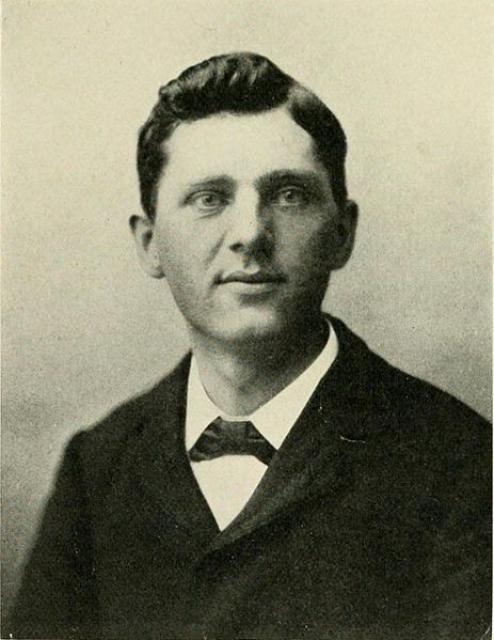
Leon Czolgosz
 USA
USA- Leon Czolgosz: The Assassination of William McKinley
- Early Life and Influences
- Inspiration and Radicalization
- The Assassination
- The Trial and Execution
Leon Czolgosz: The Assassination of William McKinley
Leon Czolgosz, the killer of the 25th President of the United States, William McKinley, was executed on the electric chair on October 29, 1901. As his final words, he stated, "I killed the President because he was the enemy of good people - good working people. I do not regret my crime." Czolgosz's father, Paul Czolgosz, migrated from the Vilna Governorate in the mid-1860s, possibly due to the census held on January 19, 1866, where nobles who couldn't prove their noble status were classified as merchants and peasants. It is also speculated that Paul, who participated in the uprising of the revolutionary Konstantin Kalinovsky, left his homeland, lived in Germany, and settled in Cleveland, fearing reprisal from the government. Since 1883, the ten-year-old Leon had to work, which was not prohibited by American laws at the time, although it was sometimes criticized by Republicans.
Early Life and Influences
During his childhood, Leon lost his mother, and his relationship with his stepmother did not start well. His stepmother's constant criticisms and petty nitpicking likely affected his personality. He also faced bullying in school, which made it difficult for Czolgosz to socialize and led to frequent job changes. He avidly read socialist and anarchist literature and eventually started attending meetings where young people shared their radical revolutionary ideas. At one of these meetings, Leon conceived the idea of assassinating prominent politicians. Despite his anarchist beliefs, Czolgosz remained a supporter of the North-Industrial Republican Party for many years.
Inspiration and Radicalization
In July 1901, Czolgosz became inspired by the fiery speeches of Emma Goldman, who advocated for "individual terrorism," one of the anarchist branches that advocated for the elimination of the lives of the most hated politicians and public figures in order to achieve social harmony. By September, Leon became one of her most devoted followers, continuing his formation as a lone terrorist. Prior to this, in 1900, he learned about the assassination attempt on King Umberto I by the Italian anarchist Gaetano Bresci, who had received his anarchist education in the United States, which deeply resonated with Czolgosz. This striking example motivated Leon to target the life of President William McKinley.
The Assassination
In late August 1901, McKinley embarked on a tour of the United States, including a visit to Niagara Falls and participation in an industrial exhibition of technological inventions planned in Buffalo. Czolgosz arrived in the city a week before the exhibition and purchased a .32 caliber revolver for $15, a significant sum at the time. On September 5, McKinley arrived at the exhibition, and on September 7, he attended a cultural event at the Temple of Music. The president was openly guarded by 11 armed soldiers from the National Army and the unseen US Secret Service. A queue formed for people who wanted to shake hands with the beloved president, and Czolgosz joined the line, concealing the revolver in the palm of his right hand wrapped in a handkerchief. Naturally, he extended his left hand...two shots rang out, and McKinley was critically wounded. The first bullet hit a button on McKinley's jacket, while the second struck him in the abdomen.
A man standing in line after Czolgosz immediately struck him on the head, knocking him to the ground. If it weren't for the fact that the guards, following the president's orders, promptly removed Czolgosz from the crowd, he would have been lynched on the spot. Czolgosz recovered from his injuries shortly in the prison infirmary and was transferred to Auburn State Prison after 20 days. William McKinley passed away on September 14. A New York newspaper interviewed Czolgosz's father, who stated that there were "no justifications for his son" and that Leon "became nothing more than a weapon in the hands of others." The anarchist publication "Die Freiheit" affirmed its approval of Czolgosz's assassination attempt but also noted that he was not a regular member of any anarchist organization.
The Trial and Execution
Any chance of justifying the killer on the basis of insanity evaporated during the trial when the defense failed to provide any evidence of his mental incompetence. Czolgosz was declared mentally sound and fully aware of his actions. On September 24, 1901, the criminal was sentenced to death. The jury took only one hour to reach a decision, recommending the death penalty on September 26. On October 29, 1901, Leon Czolgosz was executed on the electric chair, receiving three jolts of 1800 volts. His final words were, "I killed the President because he was the enemy of good people - good working people. I do not regret my crime."
John T. Gerin conducted the autopsy on Czolgosz's body, while Edward Anthony Spitzka performed the brain autopsy. Prison authorities initially planned to accelerate the decomposition process with unslaked lime but were dissatisfied with the results after testing it on a meat sample. Ultimately, sulfuric acid was poured into Czolgosz's coffin, which accelerated decomposition over a period of 12 hours.
As the guards strapped Czolgosz to the electric chair, he murmured, "I am sorry I cannot see my father."


