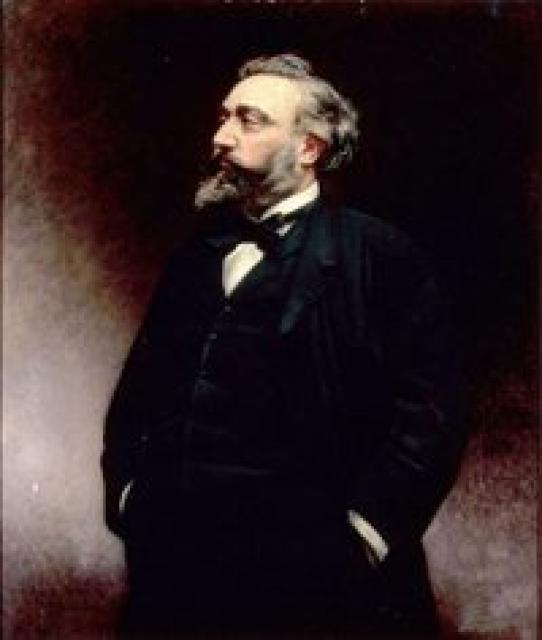
Leon Gambetta
 France
Biography of Leon Gambetta
Leon Gambetta was a French political figure and orator. He was born on April 2, 1838, in Cahors, France. Despite losing the sight in one eye at a young age, Gambetta demonstrated exceptional abilities and intelligence from an early age. He studied at the seminary in Montauban and later at the lyceum in Cahors.
Gambetta's passion for politics and his remarkable oratory skills quickly set him apart from his contemporaries. He studied law and history at the Ecole de droit in Paris for three years, during which he became actively involved in political activities. His youthful comrades recognized his leadership and authority. Gambetta's father was a small tradesman from Genoa, Italy, while his mother came from a French bourgeois family with deep roots in society.
Gambetta began his career as a lawyer and gained recognition for his defense of several political cases. His oratorical talent quickly garnered attention, and he became a prominent figure in the legal and political circles. He attended lectures at the Sorbonne and Collège de France, studying political and administrative sciences, and closely followed political debates in the legislative body.
Gambetta's political career took off when he defended journalists who had subscribed to a monument in memory of a popular representative killed during the December 1851 uprising. His powerful speech resonated throughout France and turned him into a fierce opponent of the Empire. Gambetta's name was now on everyone's lips, and he gained widespread fame and recognition.
In 1869, Gambetta was elected to the National Assembly, where he quickly established himself as an influential figure. As France faced a critical period, Gambetta advocated for the establishment of a republic and vehemently opposed the monarchy. Despite his efforts to prevent the Franco-Prussian War, it broke out, leading to the downfall of the Second Empire. Gambetta played a crucial role in organizing the defense of France during the war.
After the war, Gambetta focused on rebuilding the nation and promoting republican ideals. He traveled extensively throughout France, delivering speeches and advocating for the unity of the republican party. Gambetta was elected president of the budget committee in the newly formed chamber, where he played a vital role in shaping the country's financial policies.
However, Gambetta faced opposition from the monarchist parties, who sought to undermine the newly established republic. He fought against the influence of the Catholic Church in politics and advocated for the separation of church and state. Despite facing challenges, Gambetta remained a prominent leader of the republican party and a symbol of the French Republic.
In 1875, the National Assembly declared the republic as the legitimate form of government in France. Gambetta played a crucial role in the decision-making process and defended the establishment of a Senate, which he believed would represent the interests of local communities. He continued to fight against reactionary forces and worked tirelessly to promote republican values.
Leon Gambetta's political career was marked by his unwavering dedication to the republican cause and his ability to mobilize and unite the French people. He played a significant role in shaping the political landscape of France during a time of great upheaval. Gambetta's powerful speeches and tireless efforts made him one of the most influential figures in French politics of the 19th century.



