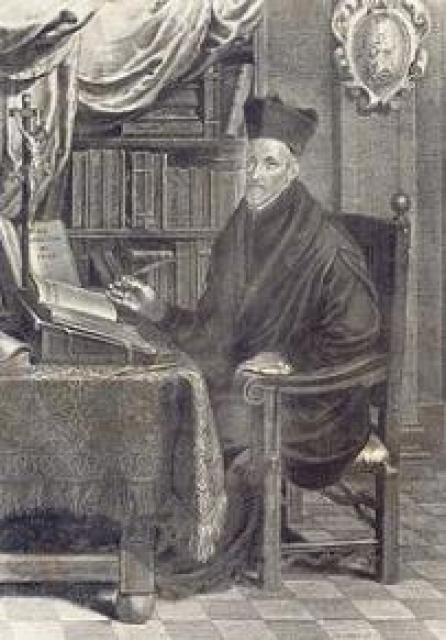
Leonardus Lessius
 Belgium
Biography of Leonard Lessius
Leonard Lessius was a Jesuit theologian known for his deep understanding of various economic issues and business matters. He was highly acclaimed by modern economic historians for his nuanced and profound perspective. Born in 1554 in Brecht, Lessius joined the Jesuits in 1572. After theological studies in Rome under the guidance of Suarez and Robert Bellarmine, he became a professor of theology at the University of Louvain.
During the early years of his teaching career, Leonard actively participated in theological discussions taking place in Louvain at the time. He is best remembered for his treatise 'De iustitia et iure' (On justice and law), which was published in 1605 and underwent 20 editions in the 17th century. This work was one of the first theological works that examined economic and financial issues alongside other topics.
Later on, Lessius went to Antwerp to study banking and commerce, believing that such knowledge could significantly enhance his understanding of many theological theories. His profound understanding of various economic problems and business issues earned him high praise from contemporary economic historians.
In 1631, his work 'On the Providence of the Deity, and the Immortality of the Soul, Against Atheists and Politicians' was translated into English and titled 'Rawleigh his Ghost'. After 1610, when Lessius's health began to deteriorate, he turned to writing more ascetic and theological books, which also enjoyed great success.
In 1615, Pope Paul V personally thanked Lessius for his services to the Catholic Church. Leonard Lessius passed away in 1623. After an initial burial at the Jesuit cemetery, his remains were reinterred at the cemetery near the historic Jesuit church, St. Michael Church, in Louvain.
Among his notable works are 'De Iustitia et Iure', 'De Bono Statu eorum qui vovent...', and 'De perfectionibus moribusque divinis'. It is worth mentioning that Lessius rarely mentioned Jesus in his theological writings. According to his opinion, the existence of God could confidently be asserted based on philosophical inquiries, daily observations, and even common sense. Therefore, God was a completely ordinary entity for him, like many other proven and unquestionable truths, and thus the question of His existence did not arise for him.


