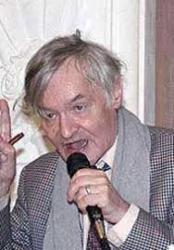
Leonid Plyush
 France
Biography of Leonid Plyushch
Leonid Plyushch was a mathematician, publicist, and participant in the human rights movement in the USSR. He was born in a working-class family in the city of Naryn, Kyrgyzstan. His father died at the front in the early days of the Great Patriotic War. Later, Leonid and his family moved to Odessa. He graduated from high school with a silver medal and entered the physics and mathematics faculty of Odessa University. He then transferred to the mechanics and mathematics faculty of Kiev University, which he graduated from in 1962.
Until 1968, Plyushch worked as a mathematical engineer at the V. M. Glushkov Institute of Cybernetics of the Academy of Sciences of Ukraine. He conducted scientific research at the intersection of mathematics and biology, modeling biosystems, and published several scientific articles. As an active participant in the dissident movement, Leonid Plyushch contributed to the spread of human rights ideas in Ukraine. He served as a link between Moscow and Ukrainian dissidents, introducing Muscovites to the latest samizdat publications from Ukraine and bringing back samizdat editions from Moscow to distribute in the republic.
In 1964, after Nikita Khrushchev's resignation as the General Secretary of the CPSU Central Committee, Plyushch wrote a letter to the Central Committee with proposals for the democratization of the Soviet system. Starting in 1966, he began writing his own articles for samizdat about the nature of the Soviet regime, the national question in the USSR, ideology, and the need for country renewal. At that time, Plyushch believed in the possibility of "socialism with a human face" and defended these ideas.
In 1968, Leonid Plyushch sent a letter to the Komsomolskaya Pravda with a sharp protest against what he considered unreliable coverage of the trial of Alexander Ginzburg and Yuri Galanskov. According to Leonard Ternovsky, "the response came quickly - Plyushch was dismissed from the Institute with a 'wolf ticket' and since then he was not accepted for any job."
However, in 1969, Plyushch found employment as a bookbinder. At the same time, he began collecting information about the human rights movement in the Soviet Union and passing it on to the editorial office of "Chronicle of Current Events". Since the formation of the Initiative Group for the Protection of Human Rights in the USSR in 1969, he became a member. Since Leonid constantly lived in Kiev, he could not actively participate in the group's work, which was based in Moscow. Therefore, his signature on some of its documents was given by proxy.
On January 15, 1972, after several searches of his apartment, Plyushch was arrested and charged under Article 62 of the RSFSR Criminal Code with anti-Soviet agitation and propaganda with the aim of undermining the existing system. Leonid Plyushch was held in custody at the Kiev KGB investigative isolation facility, where he was sent for a psychiatric examination at the Kiev Regional Hospital's forensic psychiatric department, but was declared sane. He was then sent to Moscow, where at the V. P. Serbsky Central Institute of Forensic Psychiatry he was twice diagnosed with "sluggish schizophrenia" (a diagnosis often given to dissidents) by an expert commission chaired by A. V. Snezhnevsky, with the participation of G. V. Morozov, D. R. Lunts, and A. K. Anufriev in September 1972.
In January 1973, during a closed trial at the Kiev Regional Court, Plyushch was accused of signing letters to the UN as a member of the Initiative Group, possessing and disseminating anti-Soviet literature, and engaging in anti-Soviet conversations. By court order, he was sent to compulsory treatment in a special (prison) psychiatric hospital. However, the Supreme Court of Ukraine softened the determination to compulsory treatment in a general psychiatric hospital, but after the prosecutor's protest, the decision of the regional court was restored "due to the special social danger of his anti-Soviet actions".
From July 15, 1973, Plyushch was held in the Dnipropetrovsk Special Psychiatric Hospital. According to Leonard Ternovsky, from August 1973, Plyushch was prescribed high doses of haloperidol. Prominent human rights activists, including Academician Andrei Sakharov and Corresponding Member Ilya Shafarevich, called for Plyushch's release. In 1974, Tatiana Khodorovich published the book "The History of Leonid Plyushch's Illness" in samizdat, which was later published in Amsterdam.
In 1974, an international committee for the defense of Leonid Plyushch was formed, which actively operated in France and the United States and conducted protest actions. The International Congress of Mathematicians in Vancouver published an open letter in defense of Plyushch. In March 1975, Tatiana Khodorovich wrote and published the articles "Turning Plyushch Insane. Why?" (jointly with Yuri Orlov) and "Escalation of Desperation". On April 23, 1975, an international day of defense for Plyushch was held. The Central Committee of the French Communist Party appealed to the Soviet leadership in defense of the dissident. In 1975, Vladimir Bukovsky and Semyon Gluzman dedicated their work "A Manual on Psychiatry for Dissidents" to Leonid Plyushch, writing on the title page "To Lena Plyushch - a victim of psychiatric terror". As a result of an active international campaign, Leonid Plyushch was released.
On January 10, 1976, he left the USSR with his wife and children. In Austria, he underwent a psychiatric examination, which confirmed his full sanity but diagnosed him with severe nervous exhaustion. He settled in France in exile. From 1977, Plyushch became a representative of the Ukrainian Helsinki Group abroad. In the West, Plyushch released the book "At the Carnival of History".
From the late 1970s, he gradually shifted from socialist positions to anti-communism and nationalism, and his interests shifted from politics to cultural studies and literary studies. Plyushch became a member of the Association of Ukrainian Writers "Slovo" and authored a monograph about Taras Shevchenko. In 1986, Leonid Plyushch published an article about the murder of poet Vasyl Stus. In 1991, he released a documentary-analytical video film "From Little Russia to Ukraine" and a series of articles on the formation and prospects of Ukrainian culture.