
Leopold the Cat
 Russia
Biography of Leopold the Cat
Leopold the Cat is a character from a popular Russian animated series, which was produced from 1975 to 1993 and has remained popular with both children and their parents. His most recognizable catchphrase became the unforgettable "Kids, let's live in harmony!" His main idea is pacifism, although this term might not have been in use in the USSR when the cartoon was created in 1975.
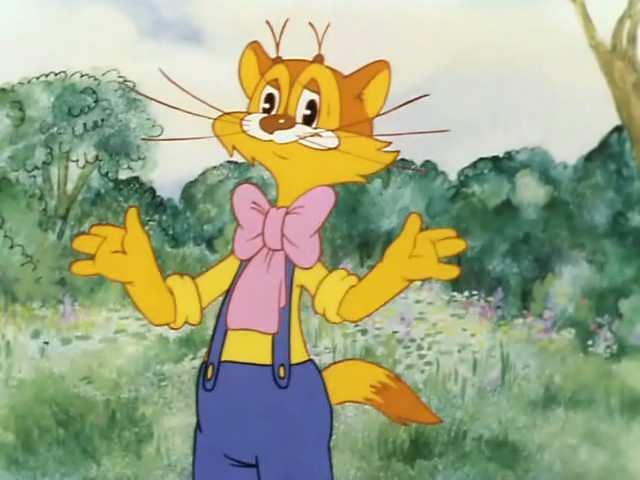
Leopold, unlike other stray cats, is a completely unique character. His main characteristic is his intelligence, which is his defining trait. Even his name, Leopold, hints to viewers that he is not just an ordinary cat, but a refined, thoughtful individual deserving of respect. Leopold does not behave rudely; he follows his own gentlemanly feline code and does not engage in petty conflicts, always maintaining his dignity. He is consistently in good spirits, always wears a bowtie, and walks exclusively on two legs, which also symbolizes his "humanity."
Leopold the Cat was created by Russian animators Anatoly Reznikov and Arkady Khait. The first episode of the animated series was released in 1975. The plot revolves around the revenge of a cat who is constantly tormented by the cunning mice, Grey and White. Despite being peaceful, the cat cannot find a proper way to defend himself against the villains. The doctor prescribes him a medicine called "Ozverin," which he mistakenly takes and it greatly disrupts the mice's lives. By the end of the cartoon, the effects of the tablets wear off, and he returns to his kind-hearted self, singing, "I can't be mad for long. I'm terribly kind," in the voice of Andrey Mironov.
It is worth noting that Andrey Mironov's voice acting greatly influenced the character of Leopold. He managed to create a certain tone that later became the standard for the character. Other talented actors, such as Alexander Kalyagin, Gennady Khazanov, Oleg Anofriev, and Vsevolod Abdulov, also voiced Leopold in different episodes.
The first episode of the series, which was filmed in 1975, was only released in 1981. There were various reasons for the delay, ranging from the cat's deviation from the party line to issues with the name. However, the creators of the cartoon persisted, and from the beginning of the 1980s, new episodes of Leopold the Cat were consistently aired on television screens.
As for Leopold himself, he continued to be an incredibly well-rounded character, sticking to his image and avoiding petty conflicts while promoting peace worldwide. In modern terms, Leopold can be described as a pacifist, peacemaker, and pundit. On the other hand, his enemies, the mice, can be described as ordinary thugs, malicious and devoid of intelligence.
Interestingly, Leopold's mannerisms led to accusations of homosexuality, although it can be assumed that the creators of the character, who lived in the USSR, did not have such intentions in mind during the late 1970s and early 1980s. It is amusing to note that due to extensive discussions about Leopold, some even identified him as Jewish, finding numerous references to Jewish humor in his quotes.
Leopold's personality is revealed in the episode "Interview with Leopold the Cat" from 1984, where he shares his thoughts. This episode, in a way, was aimed at the adult audience, with many jokes that only adults would understand. It is in this episode that Leopold admits that "movies are a dog's job." In the end, as in all the other episodes, Leopold nonchalantly adjusts his bowtie and sweetly says, "Kids, let's live in harmony!" A total of 11 episodes of the series were released, including a parody in 1993 called "The Return of Leopold the Cat."
In conclusion, the main thing that can be said about Leopold the Cat is that he is an intellectual, pacifist, and peacemaker. He is a cat without the slightest hint of aggression, yet he has a clear understanding of the world around him and his place in it. He is not cruel and does not understand senseless cruelty, although he instinctively opposes it. He remains a gentleman cat in any situation, even though the harsh reality can be painful for him. It is evident that he is destined to be misunderstood and unappreciated, but he will not deviate from his image to cater to public opinion. Even in the most unpleasant situations, he responds with his expected catchphrase, "Kids, let's live in harmony!" His tone may change from a call to a weary plea.
Interestingly, many mothers today use this cartoon as an example, contrasting it with the numerous fans of "Tom and Jerry." Leopold the Cat's cartoons are far from cruelty and, essentially, promote one main goal – living in peace.


