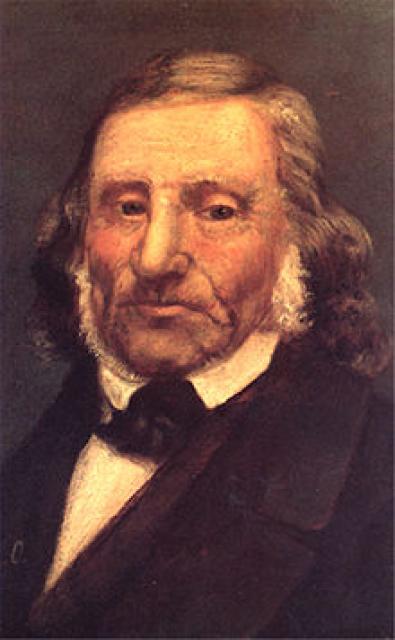
Leopold Zunz
 Germany
- Leopold Zunz: A Pioneer of Jewish Scholarship
- Early Scholarship
- Founding of the Verein für Cultur und Wissenschaft der Juden
- Contributions to Jewish Scholarship
- "Die Gottesdienstlichen Vorträge der Juden"
- "Namen der Juden"
- Other Notable Works
- "Zur Geschichte und Literatur" (On History and Literature)
Leopold Zunz: A Pioneer of Jewish Scholarship
Early Life and EducationLeopold Zunz, a prominent Jewish scholar and activist of the 19th century, was born on August 10, 1815, in Detmold, Germany. He came from a humble background, as his father, Menachem Immanuel Zunz, was a respected Talmudic scholar. After his father's death, his family faced extreme poverty, forcing him to enter a newly founded Talmudic school for indigent children at the age of eight.
Despite his financial struggles, Zunz excelled in his studies and immersed himself in the study of Jewish literature. He subsequently attended a gymnasium in Wolfenbüttel, becoming one of the first Jews to receive a gymnasium education in Germany. In 1815, he enrolled at the University of Berlin, where he studied philosophy under Schleiermacher, biblical criticism and exegesis under De Wette, and law under Savigny.
Early Scholarship
During his early years as a scholar, Zunz's research was heavily influenced by his desire to advocate a moderate reform movement within Jewish religious practices. He saw scholarship as a tool to defend his views, and his writings reflected this apologetic tone.
In 1818, Zunz published his first significant work, "Etwas über die rabbinische Literatur nebst Nachrichten über ein altes bis jetzt ungedrucktes Werk," which outlined his vision for a new field of Jewish scholarship. He argued for the creation of a scientific study of Jewish literature, religion, culture, and history, tracing its development from the end of the biblical period onward.
Founding of the Verein für Cultur und Wissenschaft der Juden
In 1819, Zunz joined forces with other like-minded scholars to establish the Verein für Cultur und Wissenschaft der Juden (Society for Jewish Culture and Science). The society aimed to promote a harmonious blending of Jewish tradition with modern culture and served as a platform for Zunz's research and advocacy.
Contributions to Jewish Scholarship
Zunz's contributions to Jewish scholarship were vast and groundbreaking. His meticulous research and innovative methodology set the stage for the development of modern Jewish studies.
"Die Gottesdienstlichen Vorträge der Juden"
One of Zunz's most significant works was "Die Gottesdienstlichen Vorträge der Juden" (The Liturgical Sermons of the Jews), published in 1832. This comprehensive study traced the history of homiletic literature among Jews and provided a valuable resource for understanding the cultural and religious significance of sermons.
"Namen der Juden"
In 1837, Zunz published "Namen der Juden" (The Names of Jews), which explored the origins and significance of Jewish personal names. This study prompted the Prussian government to lift its prohibition on Jews using Christian names.
Other Notable Works
Zunz also authored several other important works, including:"Geographische Literatur der Juden" (Geographical Literature of the Jews)
"Zur Palästinischen Geographie aus jüdischen Quellen" (On Palestinian Geography from Jewish Sources)
"Synagogale Poesie des Mittelalters" (Synagogue Poetry of the Middle Ages)
"Zur Geschichte und Literatur" (On History and Literature)
Retirement and LegacyIn 1864, Zunz celebrated his 70th birthday, which was marked by the establishment of the "Zunz'sche Stiftung" by Neuman and Bleichröder in his honor. In 1875-1876, a collection of Zunz's writings was published in three volumes, although it excluded his major works.
Zunz died on March 17, 1886, leaving behind a legacy of groundbreaking scholarship and tireless advocacy for Jewish culture and traditions. His life and work continue to inspire generations of Jewish scholars and activists.


