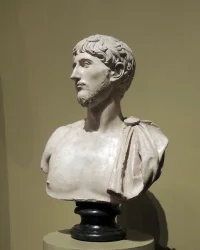
Lepidus
Marcus Aemilius Lepidus was a Roman politician and general who became one of the three leaders of the Second Triumvirate alongside Octavian and Mark Antony. For a time he controlled Rome and later governed the province of Africa, but his influence dwindled as his partners gained power. After a failed bid to assert authority in Sicily in 36 BCE, Octavian stripped him of his military and political powers. Lepidus nevertheless remained Rome’s chief priest until his death.
Caesar’s ally
Lepidus was born into a prominent Roman family around 90 BCE. He rose through the political ranks during the final decades of the Republic and became an ally of Julius Caesar. He served as consul in 46 BCE and as Caesar’s master of the horse, a senior military and political position.
After Caesar’s assassination in 44 BCE, Lepidus supported Mark Antony and helped stabilize Rome while the political crisis unfolded. He also became pontifex maximus, the head of Rome’s state religion. The rivalry among Caesar’s heirs led to an alliance between Lepidus, Antony, and Octavian. In 43 BCE, they formed the Second Triumvirate, a legally recognized governing commission with sweeping powers.
Triumvir and provincial ruler
The triumvirs used proscriptions—lists of political enemies whose property could be seized and who could be killed—to eliminate opponents and raise funds. Cicero was among those executed. Lepidus shared responsibility for this brutal policy, even as his influence within the alliance gradually became weaker.
After the triumviral forces defeated Brutus and Cassius at Philippi in 42 BCE, Lepidus received control of the province of Africa. He spent much of the next several years outside Rome, while Antony and Octavian competed for dominance. In 36 BCE, Lepidus joined Octavian’s campaign against Sextus Pompey in Sicily. Once the campaign succeeded, Lepidus tried to claim Sicily and a larger share of power.
Octavian persuaded Lepidus’s soldiers to change allegiance. Lepidus surrendered and was removed from the triumvirate and his commands. He was sent to live at Circeii, under supervision, but was allowed to keep the office of pontifex maximus. He held that religious office until his death around 13 or 12 BCE, when Augustus assumed it.
Legacy
Lepidus is often remembered as the least powerful member of the Second Triumvirate, but his early role was significant. His political and military support helped make the alliance possible, and he shared in the government that defeated the Republic’s remaining defenders. His later defeat shows how Octavian consolidated control while formally preserving the old religious and political institutions.