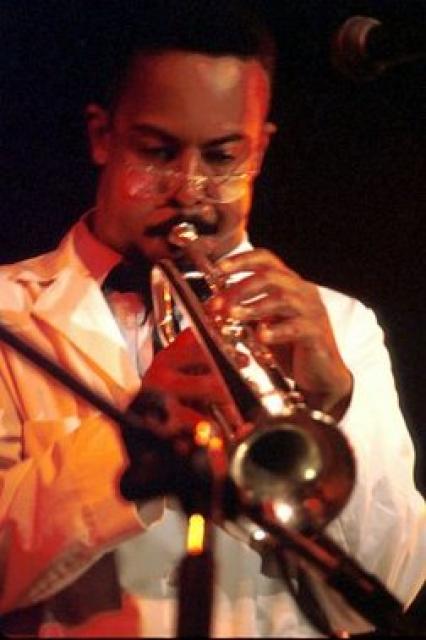
Lester Bowie
 USA
USALester Bowie: Biography
IntroductionLester Bowie was an American jazz trumpeter who was considered the best in avant-garde jazz from the 1970s until his death in 1999. He was one of the few trumpeters of his generation who successfully adopted the techniques of free jazz. Bowie achieved great success in adapting jazz compositions for the traditionally difficult trumpet, which is better suited for saxophone due to its easy tonal shifts. His playing style resembled the sound of a human voice more than that of most contemporary trumpeters. In a way, Bowie seemed to turn back to the pre-jazz era of musicians like Buddy Bolden and Bubber Miley. While not being a retrograde, he also wasn't afraid to utilize the techniques of early jazz musicians, making his trumpet screech and growl. This peculiar and abrupt change in sound was founded on a modern understanding of music and the fundamental concepts of jazz in terms of melody, harmony, and rhythm. Bowie's music often created a comical effect, but it equally encouraged listeners to think broadly and dance.

Early Life and Career
Lester Bowie grew up in St. Louis and began playing in local jazz bands and rhythm and blues groups, including bands led by Little Milton and Albert King. In 1965, Bowie moved to Chicago, where he became the musical director for singer Fontella Bass. In the new city, Bowie met many musicians with whom he would later make a name for himself. Among them were saxophonists Joseph Jarman and Roscoe Mitchell, as well as drummer Jack DeJohnette. In 1969, Lester Bowie became one of the co-founders of the Association for the Advancement of Creative Musicians and the Art Ensemble of Chicago. Among the various jazz bands in which Bowie performed, there was From the Root to the Source, which played a fusion of gospel music, jazz, and rock, and Brass Fantasy - a postmodern big band consisting solely of brass instruments, which brought Bowie the greatest fame. Bowie's liberal views were reflected in the repertoire of the ensemble, with albums containing cover versions of diverse compositions, ranging from Jimmy Lunsford's "Siesta for the Fiesta" to Michael Jackson's "Black and White." In addition to his work as a leader of musical ensembles and his administrative activities, Bowie also participated in recordings by other musicians, including DeJohnette, percussionist Kahil El'Zabar, composer Kip Hanrahan, and saxophonist David Murray. He was also a member of the star-studded 1980s supergroup known as The Leaders.