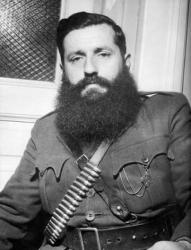
Lev Karahan
- Lev Mikhailovich Karakhan
- Political Activism and Exile
- Return to Petrograd and Revolution
- Diplomatic Career
- Arrest and Execution
Lev Mikhailovich Karakhan
Early Life and EducationLev Mikhailovich Karakhan, a prominent revolutionary and Soviet diplomat, was born in the Kutaisi province of the Russian Empire into a family of a lawyer. An Armenian by ethnicity, he graduated from the Tiflis Real School and pursued legal studies at the University of St. Petersburg from 1910 to 1915, although he did not complete his degree there. Karakhan also completed a law degree at Tomsk University in 1916 through an external program.
Political Activism and Exile
Karakhan joined the Russian Social Democratic Labour Party (RSDLP) in 1904 as a Menshevik. He engaged in party work in Harbin and St. Petersburg, and from 1912 onwards, he became involved in the trade union movement. In 1913, he joined the St. Petersburg organization of the United Social Democrats (Bolsheviks and Mensheviks), actively participating in agitation, propaganda, and organizational activities.
With the outbreak of World War I, Karakhan adopted an internationalist stance, advocating for a break with the defense advocates within the party. He played a key role in organizing the journals "Textile Worker," "Workers' Gazette," and the illegal "Forward," and established an illegal print shop in Chubarov Lane. In the autumn of 1915, Karakhan was arrested and exiled to Tomsk, where he continued his clandestine activities within the Irkutsk organization and contributed to the social democratic press in Transbaikalia.
Return to Petrograd and Revolution
After the February Revolution, Karakhan returned to Petrograd and became a member of the Petrograd District Duma and Petrograd Soviet. In May 1917, he joined the Bolsheviks as part of the "Inter-District Group." From August 1917, he served as a member of the Presidium of the Petrograd Soviet, and in November, he was appointed secretary of the Soviet delegation at the peace negotiations in Brest-Litovsk.
In March 1918, Karakhan signed the Treaty of Brest-Litovsk, which ended Russia's participation in World War I. He subsequently became the Deputy People's Commissar for Foreign Affairs of the Russian Soviet Federative Socialist Republic (RSFSR).
Diplomatic Career
Karakhan's diplomatic career spanned several key roles. From May 1921 to October 1922, he served as the RSFSR plenipotentiary representative to Poland. Following that, he headed the Eastern Department of the People's Commissariat for Foreign Affairs (NKID) from 1922 to 1923.
In September 1923, Karakhan was dispatched to China, where he negotiated and signed the Soviet-Chinese agreement on the Chinese Eastern Railway. In January 1925, he concluded the Soviet-Japanese Basic Treaty on Principles of Relations, and in April of that year, he was elected Dean of the Diplomatic Corps in Beijing.
Karakhan returned to Moscow in 1926 and resumed his role as Deputy People's Commissar for Foreign Affairs, a position he held until 1934. During this period, he also served as the plenipotentiary representative of the USSR to Turkey.
Arrest and Execution
In May 1937, Karakhan was summoned to Moscow and arrested. On September 20, 1937, he was sentenced to death by the Military Collegium of the Supreme Court and executed that same day. His body was cremated at Donskoy Monastery. Karakhan was posthumously rehabilitated in 1956.