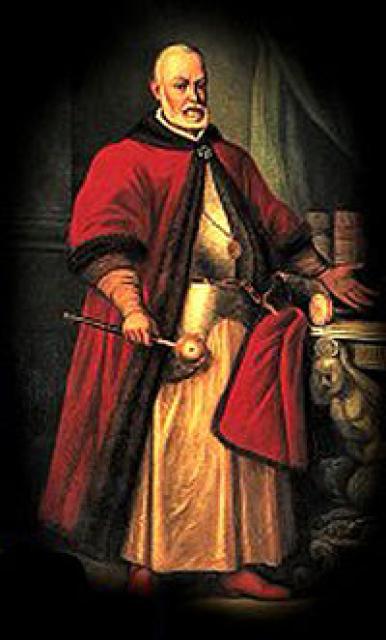
Lev Sapega
 Belarus
Biography of Lev Sapieha
Early Life and EducationLev Sapieha was born in the ancestral estate of Ostrovo in the Vitebsk district of the Grand Duchy of Lithuania (present-day Belarus). He came from the Sapieha noble family, which was known for its political, social, and military influence in the region. His father, Ivan Ivanovich Sapieha, served as a local official, and his mother, Princess Bohdana Drucka-Sokolinska-Konopli, came from a prominent noble family.
Sapieha received his education from Calvinist tutors in the renowned Nesvizh court of Nicholas Radziwill the Black, a powerful nobleman and chancellor of the Grand Duchy of Lithuania. During his studies, Sapieha converted to Protestantism and became fluent in several languages, including Greek, Latin, German, Polish, and Belarusian.
Political and Military Career
In 1570-1573, Sapieha studied at the University of Leipzig in Germany, where he honed his skills in law, diplomacy, and philosophy. Upon his return to his homeland, he successfully represented himself in a property lawsuit against his own father, impressing King and Grand Duke Stefan Batory with his legal acumen. Sapieha became a court secretary and participated in military campaigns alongside Batory, leading a cavalry unit during the liberation of Polotsk in the final stage of the Livonian War.
Sapieha continued his rise in the political arena, serving as a secretary and scribe for the Grand Duchy of Lithuania. He played a key role in the establishment of the Supreme Tribunal of the Grand Duchy, the highest judicial and appellate body in the state. In 1584, he negotiated a peace treaty with Tsar Feodor Ivanovich of Russia, securing the release of Belarusian prisoners held captive in Moscow. For his diplomatic success, Sapieha was appointed as the deputy chancellor of the Grand Duchy of Lithuania and later became the starosta (governor) of Slonim.
Later Years and Contributions
In 1586, Sapieha converted to Catholicism, which further enhanced his political career. He supported the union between the Catholic and Orthodox Churches during the Brest Union Council of 1596. Sapieha played a crucial role in the preparation and financing of the third Statute of the Grand Duchy of Lithuania in 1588, which served as a legal cornerstone for the region for over two centuries.
Throughout his career, Sapieha advocated for the sovereignty of the Grand Duchy of Lithuania within the Polish-Lithuanian Commonwealth. He defended the rights of the nobility and supported a centralized democratic state. Sapieha also contributed to the development of Belarusian printing and assembled a vast library in his residence in Ruzhany.
In his later years, Sapieha resided in Vilnius, where he focused on organizing the archives of the Grand Duchy of Lithuania. He died in Vilnius and was buried in the Church of St. Michael.
Lev Sapieha played a significant role in the history of Belarus during the late 16th and early 17th centuries. He was a devoted patriot and a respected statesman who devoted himself to serving his homeland.