Lewis H. Morgan
- From Law to the Study of the Haudenosaunee
- The Iroquois and Kinship
- Ancient Society and Its Limits
- Final Years and Legacy
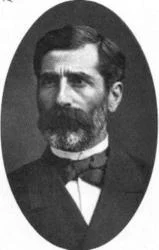
Lewis Henry Morgan began as a lawyer and railroad investor, then became one of the nineteenth century’s most influential students of kinship and social organization. His friendship and collaboration with Seneca people opened a sustained study of Haudenosaunee life, while his books carried that research into debates about how societies change. Morgan’s work helped establish anthropology as a comparative field, even as the evolutionary ladder he built around his findings is now regarded as deeply flawed.
From Law to the Study of the Haudenosaunee
Morgan was born on November 21, 1818, near Aurora in western New York. He studied at Union College, graduating in 1840, and trained as a lawyer. After moving to Rochester in 1844, he joined a fraternal organization whose members adopted the name and imagery of the Iroquois Confederacy. The group’s interest soon became more serious: it sought to defend Haudenosaunee land rights against the Ogden Land Company.
A chance meeting with Ely S. Parker, a Seneca leader and interpreter, changed Morgan’s course. Parker introduced him to Seneca history, language, and political life, and became a close collaborator. In 1846, Morgan was adopted into the Seneca Hawk Clan and given the name Ta-ya-da-o-kuh, often translated as “Bridge.” His research and collecting for the New York State Cabinet of Natural History relied on the essential assistance of Parker and other members of the Parker family.
Morgan did not simply live as a Seneca community member, despite later romanticized accounts. He remained an outsider, and his relationship with Haudenosaunee society existed alongside his work in law and business. Although he publicly supported Seneca land rights, he invested in railroad ventures that were also tied to expansion across Native lands, a contradiction that complicates his legacy.
The Iroquois and Kinship
In 1851, Morgan published The League of the Ho-dé-no-sau-nee, or Iroquois. The book described the Confederacy’s political organization and social life, drawing on research and conversations with Seneca informants. It became one of the earliest sustained ethnographic studies of a Native American society and gave readers a detailed account of a political system that many white Americans had misunderstood or dismissed.
Morgan’s questions about kinship led to a broader comparative project. In Systems of Consanguinity and Affinity of the Human Family, published in 1871, he organized information on kinship terms collected from societies around the world. He recognized that people who spoke different languages could use similar systems for naming relatives, and that such terminology revealed patterns in social organization. His systematic comparison became a foundation for later anthropological work on kinship.
Morgan also pursued a strikingly different research interest: beavers. His 1868 book, The American Beaver and His Works, studied their behavior and architecture, reflecting his curiosity about animal societies as well as human ones. In public life, he invested in mining and railroads and served in the New York State Assembly in 1861 and the state Senate from 1868 to 1869. He married Mary Elizabeth Steele in 1851; they had three children.
Ancient Society and Its Limits
Morgan’s best-known work, Ancient Society, appeared in 1877. It proposed that human societies moved through universal stages he called “savagery,” “barbarism,” and “civilization,” with technological change, family systems, government, and property serving as markers of development. He believed that the study of living societies could illuminate the deep past of humanity.
The scheme made Morgan influential, but its ranking language reflected nineteenth-century assumptions that treated Western industrial society as the culmination of human progress. Contemporary anthropology rejects the idea that all cultures follow one fixed ladder from “primitive” to “advanced.” Many specific claims in his model have also been superseded by archaeological, historical, and ethnographic research.
Still, the scale of the evidence he assembled and his focus on kinship patterns left a durable mark. Karl Marx studied Morgan’s work, and Friedrich Engels drew on Ancient Society in The Origin of the Family, Private Property and the State. Their use of his theories helped make his book influential in political debates far beyond academic anthropology.
Final Years and Legacy
Morgan died in Rochester on December 17, 1881. His will provided for his wife and son and left the remainder of his estate to the University of Rochester, with the aim of establishing a college for women. He also bequeathed his library and manuscripts to the university, preserving a substantial record of his scholarship.
Morgan’s legacy is neither a simple story of pioneering science nor one of unqualified celebration. His careful comparisons and attention to Native social systems helped shape the study of anthropology, and his Seneca collaborators were central to that achievement. At the same time, his theories imposed a hierarchy on diverse cultures, and his economic interests were entangled with the expansion he sometimes opposed. The field continues to inherit both his questions and the need to examine the assumptions with which he answered them.